


Package of 5 Sessions
- Rs.5,999.00/-
Emotional intelligence in relationships is the difference between connection and distance. Here's what it actually looks like, why it matters, and how to build it.
 Dr. Neha Mehta
  26 Jun 2026
  Marriage & Relationship
  1.2k Reads
  8 min Read
Think about the last time a conversation with someone you love went wrong. Nobody was technically lying. Nobody was being cruel. But something got lost , a need that didn't land, a feeling that got dismissed, a moment where both of you were talking and neither of you felt heard.
That gap , right there , is usually an emotional intelligence problem
Emotional intelligence in relationships is the capacity to recognise, understand, and manage your own emotions while genuinely responding to the emotions of the people you're close to. It's not about being endlessly patient or never getting hurt. It's about what happens after the hurt , whether it creates connection or distance, whether feelings get expressed or buried, whether the relationship grows from hard moments or quietly erodes through them.
Most relationship problems aren't about compatibility. They're about this. Here's what it actually looks like , and what you can do about it.
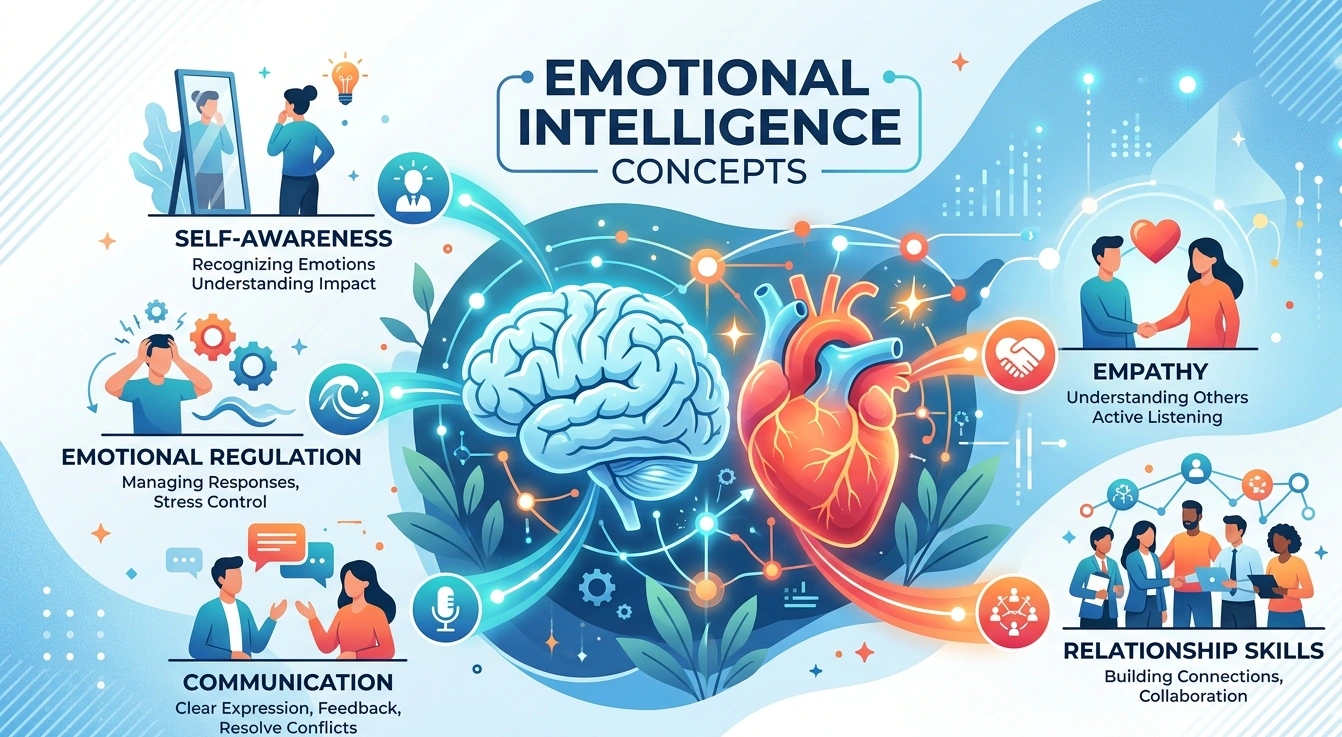
Psychologist Daniel Goleman, whose foundational research on emotional intelligence shaped how we understand the concept, identified five core components: self-awareness, self-regulation, motivation, empathy and understanding, and social skills.
In the context of relationships, these translate practically:
Emotional intelligence in relationships isn't a fixed trait. It's a set of skills. Some people come to them naturally from how they were raised. Others have to build them deliberately, slowly, often with support. But they're learnable , which matters more than where you start.
Two people can be completely compatible on paper , same values, same life goals, genuine attraction , and still create a relationship that feels chronically disconnected. The missing variable is almost always emotional intelligence.
Low emotional intelligence in relationships produces a specific, recognisable pattern:
The research is consistent. According to studies on relationship satisfaction, self-awareness in relationships and empathy are stronger predictors of long-term relationship health than attraction, shared interests, or even conflict frequency. It's not how much you fight. It's what you do with the feeling when the fight is over.
The 65% rule , a concept gaining traction in relationship therapy , proposes that a healthy partnership should meet roughly 65% of your emotional needs. The remaining 35% needs to come from elsewhere: your own inner resources, friendships, family, personal interests, and the relationship you have with yourself.
This sounds clinical but it's actually one of the more freeing ideas in modern relationship thinking.
The cultural script says your partner should be your everything , your best friend, your therapist, your cheerleader, your safe space, your adventure partner, simultaneously. That's an enormous weight to place on one person. And it quietly sets every relationship up for a sense of insufficiency, because no single human can meet every emotional need another human carries.
Emotional intelligence in relationships includes understanding this clearly , that expecting 100% from a partner isn't love, it's pressure. The 65% framework creates space:
The couples who struggle most are often the ones whose entire emotional ecosystem is the relationship. When it wobbles, everything wobbles. The 65% rule is a structural question worth asking honestly: Am I depending on this one person for too much?
These show up in the small moments far more than the big dramatic ones.
High emotional intelligence looks like:
Low emotional intelligence looks like:
Neither list is a character verdict. They're skill levels. And skill levels change.
Physical intimacy gets the most cultural airtime. But ask most women what makes them feel genuinely close to someone , and the answer is almost never physical.
It's emotional empathy. Being truly seen.
Not performing the right version of yourself. Not being loved for what you do or how useful you are. Being known , the complicated, inconsistent, still-figuring-things-out version , and chosen anyway.
The highest form of intimacy is the experience of saying something that feels risky , a fear, a shame, a need, an ugly feeling , and having the other person stay. Not fix it. Not minimise it. Stay with it, and with you.
Emotional intelligence in relationships is what makes that kind of intimacy possible. It requires someone who can sit with another person's emotional reality without becoming overwhelmed, defensive, or absent. Someone whose emotional regulation is stable enough that vulnerability doesn't trigger withdrawal. Someone who has developed enough empathy and understanding that another person's pain registers as pain , not as a problem to solve or a demand to manage.
This is the kind of closeness that sustains long-term relationships. Not chemistry , though that matters early. The capacity for genuine emotional presence. That's what keeps two people actually choosing each other, year after year.
Start with yourself, not your partner. The most common mistake is approaching emotional intelligence as a project to fix the other person. It starts with your own inner work , understanding your own emotional patterns, triggers, defaults under stress. Self-awareness in relationships can't be skipped.
Name what you're feeling before you express it. This is harder than it sounds. Most people go straight from feeling to behaviour , and the behaviour becomes what the conversation is about instead of the feeling underneath it. Slow that down. "I'm feeling scared right now" opens a conversation. "You always do this" closes one.
A few things that build it consistently:
My Fit Brain works with people who recognise the patterns in their relationships and want to understand them well enough to actually shift , not just manage. Mental health counselling focused on relationship communication and emotional skill-building does something self-awareness alone can't quite reach.
Emotional intelligence in relationships is not a personality trait you either have or don't. It's a set of skills , learnable, buildable, worth working on deliberately.
The connection most people want from their relationships , the being-seen kind, the staying-through-the-hard-parts kind , requires this. Not perfection. Not the absence of conflict. Just two people willing to keep developing the capacity to actually reach each other.
That willingness is where it starts.
If your relationship keeps hitting the same walls , same arguments, same distance, same unmet needs , a few sessions with a qualified therapist can help you understand what's underneath and build something different.
The Kickstarter , 5 sessions at ₹5,999. Same therapist throughout, 30 minutes each, from your phone. 100% confidential.
Start by asking , genuinely, not as a formality. Most emotional needs go unmet not because a partner doesn't care but because they're never clearly expressed or asked about. Key things that consistently matter:
Research consistently shows men tend to fall in love faster and report it earlier than women. Women typically take longer , not because they feel less, but because emotional empathy and self-awareness in relationships often lead them to evaluate emotional safety more carefully before full investment. Falling first doesn't determine who loves more , it's about timing and wiring, not depth.
Yes , this is one of the most important things to know about it. Emotional intelligence in relationships is a skill set, not a fixed trait. Emotional empathy, emotional regulation, relationship communication , these all develop with practice, honest self-reflection, and in many cases, working with a qualified therapist who can help identify the specific patterns holding you back.
Low emotional intelligence tends to look like feelings expressed through behaviour , withdrawal, sarcasm, stonewalling , instead of direct communication. Other signs include difficulty sitting with a partner's emotions without fixing or dismissing, taking everything personally, and an inability to repair after conflict. These aren't character flaws; they're underdeveloped skills.
Self-awareness in relationships means knowing your own triggers, defaults, and emotional patterns before they act through you. When you can recognise "I'm shutting down because this feels threatening, not because my partner did something wrong" , the conversation changes entirely. It creates a gap between feeling and reaction, and that gap is where better choices live.

Online
English, Punjabi, Haryanvi
Couple Counseling, Marital Counselling, LGBTQ, Addiction, Depression

It's 7pm. You've been making decisions since you woke up , wh...
 27 Jun 2026 8 min Read 1.2k Reads
Nobody told you your childhood was hard. That's part of the probl...
24 Jun 2026 8 min Read 1.6k Reads 
You can be surrounded by people and still feel completely alone. Most...
23 Jun 2026 8 min Read 907 Reads 
You say yes when you mean no. You apologise for things that aren'...
22 Jun 2026 8 min Read 715 Reads 
Area Of Expertise : Couple Counseling, Marital Counselling, LGBTQ, Addiction, Depression, Family Counseling, Relationship Counselling, Anger Management, Sexual Wellness, Marriage & Couple Counselling
Book a Session
Better mental health at your convince
