


Package of 5 Sessions
- Rs.5,999.00/-
Decision fatigue is why your brain gives up by evening , even on easy choices. Here's what's causing it, what the symptoms actually look like, and how to fix it.
 Dr. Neha Mehta
  27 Jun 2026
  General
  1.2k Reads
  8 min Read
It's 7pm. You've been making decisions since you woke up , what to eat, what to wear, how to respond to that message, which tasks to prioritise, what to say in that meeting, whether to push through or cancel plans.
And now someone asks "what do you want for dinner" and something in you just gives up entirely.
Not because it's a hard question. Because there's genuinely nothing left. The capacity is spent , and that's not a metaphor.
That's decision fatigue. The deterioration in thinking quality and emotional resilience that builds from making too many decisions, leaving you unable to choose clearly, weigh options properly, or function the way you normally would by the end of the day.
It's more impactful than most people realise , and more treatable than it feels. Here's what's actually happening, why, and what to do about it.
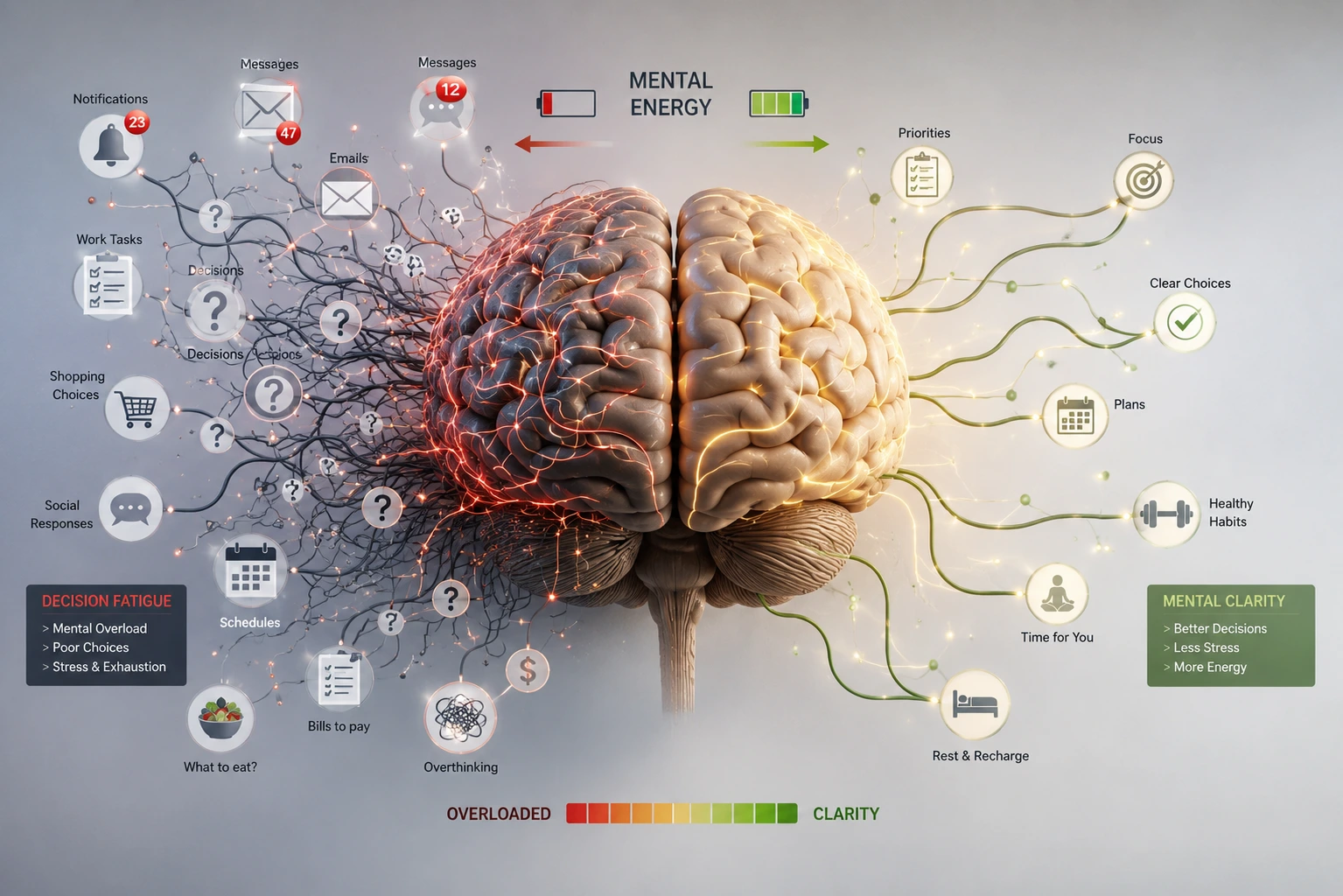
Decision fatigue describes the measurable decline in decision-making quality after a sustained period of making choices. It was first studied in judges and parole hearings , researchers found that rulings became significantly more favourable after meals and progressively harsher as the day wore on, with no change in the cases themselves. The only variable was decision volume and time elapsed.
The brain treats decision-making as a finite resource. Every choice you make , no matter how minor , draws from the same pool. Morning, the pool is full. By evening, after hundreds of micro-decisions and several significant ones, what remains is depleted and inconsistent.
Decision fatigue doesn't mean you stop being able to decide. It means decisions get worse in a specific, predictable pattern:
Modern life maximises this. Constant notifications, endless options, the low-level management of information all day , every small response draws from the same reserve as a significant life decision.
The pattern is usually more visible in hindsight than in the moment. Most people notice the consequences before they connect them to the cause.
Burnout symptoms and decision fatigue share a surface , the exhaustion, the cognitive fog, the inability to perform at previous capacity. The key difference is duration. Decision fatigue is typically acute and resolves with rest. Burnout symptoms are chronic and require significantly more sustained change to address.
But sustained decision fatigue , especially in high-pressure work or caregiving contexts , accelerates burnout meaningfully. The brain can only carry so much daily depletion before the recovery stops being full.
Stress and decision making interact in a compounding way: stress increases the volume of decisions you face while simultaneously reducing the cognitive resources available to handle them.
Common causes:
Cognitive overload from digital life sits underneath all of this. Notifications, messages, the low-level information management that fills gaps between tasks , each one registers as a small decision and draws from the same reserve.
The 10-10-10 rule is a framework designed to reduce the anxiety and paralysis that decision fatigue creates around choices that feel enormous in the moment but aren't.
The method is simple. Before deciding, ask:
The goal isn't accurate prediction. It's perspective. Most decisions that feel overwhelming under stress and decision making pressure , especially late in the day when the tank is already low , shrink considerably at the 10-month horizon. The rule forces a zoom-out that the depleted brain isn't doing on its own.
Where it works best:
What it doesn't solve is structural decision fatigue , the daily volume problem. For that, you need systemic changes, not better frameworks for individual choices. But as a tool for breaking a spiral at the point of paralysis, it's consistently underused and genuinely effective.

The answer isn't willpower. It's design. Structure your environment and schedule so the fatigue accumulates less , rather than trying harder to push through depletion that shouldn't have built up in the first place.
What actually works:
Cognitive capacity is highest in the morning. Schedule significant choices , financial, professional, relational , before midday, not at 7pm when the reserve is already spent.
Respond to messages and emails in two windows rather than continuously. Make recurring decisions on a schedule rather than each time they arrive.
Open, undecided things are cognitively expensive , they sit in the background and keep drawing from the reserve. Commit to a specific time to decide and honour it.
"I can't make a good decision about this right now" is a complete, accurate sentence. Not weakness , clarity.
Mental exhaustion from decision overload needs genuine rest , not passive scrolling, which still generates micro-choices, but unstructured downtime that asks nothing of the brain.
Mental health tips for decision fatigue also mean examining whether the volume you're managing daily is sustainable , or whether it's a symptom of overextension that strategy alone won't fix.
My Fit Brain works with people where cognitive overload and mental exhaustion have crossed from something recoverable into a persistent baseline , where the fog and depletion have become the norm rather than the exception. That shift is when mental health counselling becomes part of the real conversation.
Occasional decision fatigue is universal. It's an evening problem, not a mental health concern.
But when it's chronic , when depletion doesn't resolve with rest, when cognitive overload is the baseline, when overthinking and anxiety around decisions is affecting your work, your relationships, or your sense of yourself as a competent person , something more needs attention.
Chronic decision fatigue alongside sustained stress and decision making pressure is one of the cleaner early signals of the conditions that precede burnout. The brain is communicating that the current load isn't manageable. Not as weakness. As information.
If a weekend doesn't reset it. If simplifying hasn't shifted it. If the fog is consistent , that's worth taking seriously before it becomes something harder to address.
Read More: How Online Therapy Works , And Whether It's Right for You
Decision fatigue is one of the quietest, most consistently underestimated drains on modern life. The exhaustion gets normalised, the declining choices get blamed on personality, and the fog becomes so familiar it stops registering as a problem.
Your capacity to think clearly and choose well is finite and renewable. Treating it that way , protecting it deliberately, recovering it intentionally , isn't indulgence. It's one of the most practical things you can invest in.
The decisions that actually matter deserve the version of you that hasn't already been spent on everything else.
If mental exhaustion and cognitive depletion have stopped feeling temporary , talking to a qualified therapist can help you understand what's sustaining it and what to actually do about it.
The Transformation , 10 sessions at ₹9,999. Same therapist throughout, 30 minutes each, from your phone. 100% confidential.
Decision fatigue is the deterioration in decision quality and emotional resilience that results from making too many choices over a period of time. The brain treats decision-making as a finite resource , and when that resource runs low, decisions become impulsive, avoidant, or defaulted rather than genuinely considered. It's neurologically real, not a mindset problem.
A clear example: a doctor who makes careful, considered diagnoses in the morning starts recommending default treatments by late afternoon , not because the cases changed, but because the cognitive resource did. In everyday life it looks like:
Yes , it's well-supported by research across medicine, law, finance, and consumer behaviour. It's not a clinical diagnosis but a documented cognitive phenomenon with measurable effects on choice quality, overthinking and anxiety, and mental exhaustion. The research on judges' parole decisions remains one of the most cited examples of how real and impactful the effect is.
Yes, and the relationship runs both ways. Overthinking and anxiety make decision fatigue worse by adding rumination on top of decision volume , the same decisions get processed multiple times. And decision fatigue increases stress and decision making anxiety by degrading the brain's confidence in its own judgment. Chronic decision fatigue is also a known contributor to burnout symptoms over time.
Acute decision fatigue typically resolves overnight with good sleep , the prefrontal cortex recovers during rest. A day of genuinely low decision volume also helps significantly. Chronic decision fatigue , where depletion has become the baseline , takes longer and usually requires structural changes to workload and recovery patterns, not just rest.

Online
English, Punjabi, Haryanvi
Couple Counseling, Marital Counselling, LGBTQ, Addiction, Depression

Think about the last time a conversation with someone you love went wrong. ...
 26 Jun 2026 8 min Read 1.2k Reads
Nobody told you your childhood was hard. That's part of the probl...
24 Jun 2026 8 min Read 1.6k Reads 
You can be surrounded by people and still feel completely alone. Most...
23 Jun 2026 8 min Read 910 Reads 
You say yes when you mean no. You apologise for things that aren'...
22 Jun 2026 8 min Read 718 Reads 
Area Of Expertise : Couple Counseling, Marital Counselling, LGBTQ, Addiction, Depression, Family Counseling, Relationship Counselling, Anger Management, Sexual Wellness, Marriage & Couple Counselling
Book a Session
Better mental health at your convince
