


Package of 5 Sessions
- Rs.5,999.00/-
Learn how to control anger issues with therapist-backed techniques to manage emotional outbursts, improve relationships, and calm anger in healthy ways.
 Dr. Neha Mehta
  13 May 2026
  Anxiety
  513 Reads
  10 min Read
You didn't mean to say it that way. You didn't mean to slam the door. You didn't mean to send that message. But something tipped, and suddenly everything you'd been holding in came out — louder, harsher, more cutting than you intended.
And now, in the quiet aftermath, comes the familiar guilt.
If this is a pattern you recognise, you are not a bad person. You are a person with an anger management problem — and those two things are not the same. Anger itself is not the enemy. It is a normal, biologically necessary emotion that signals when a boundary has been crossed or when something feels unfair. The problem is not that you feel anger. The problem is what happens between feeling it and expressing it.
The good news: learning how to control anger issues is a skill, and like all skills, it can be learned and strengthened. Whether you are trying to figure out how to control anger in a relationship, at work, or simply understand why do I get angry so easily — these 12 techniques are what therapists actually use.
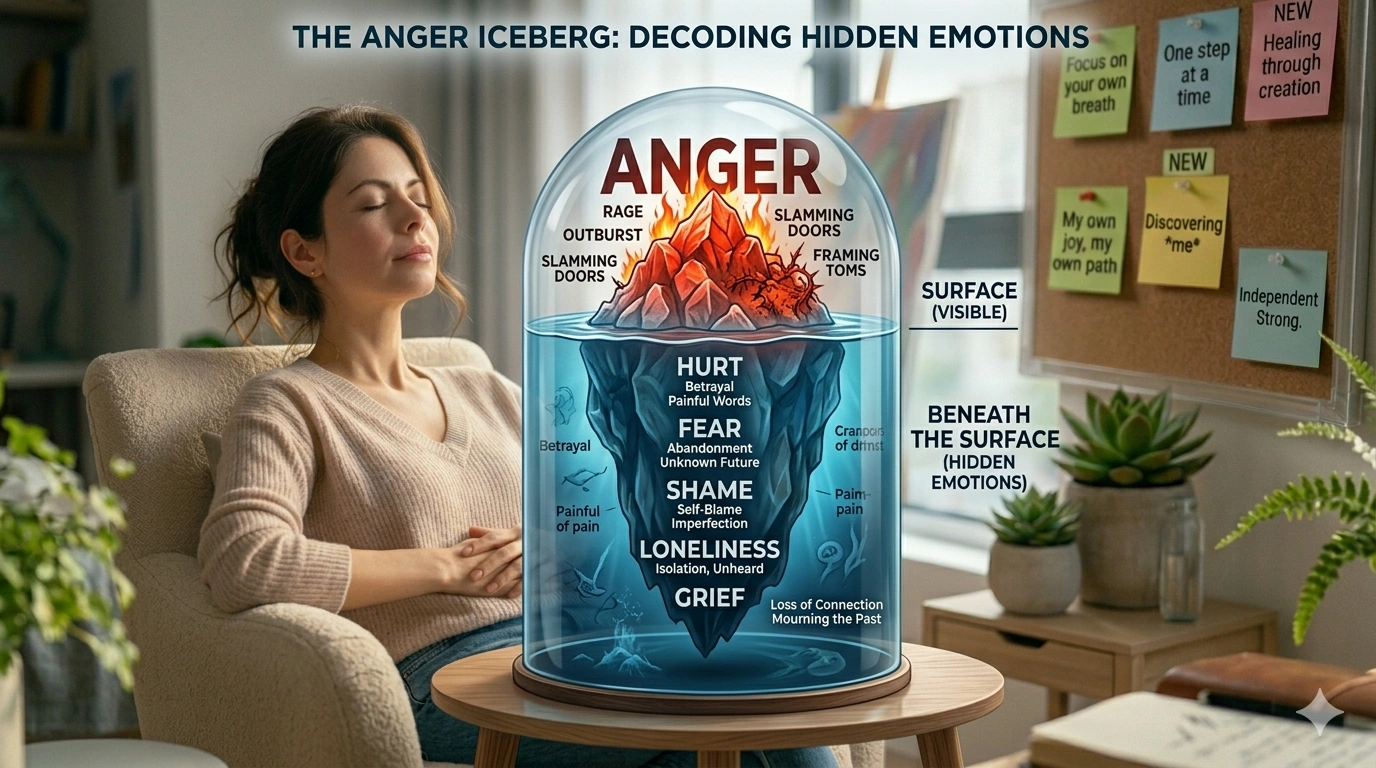
Before any technique, there is a concept you need to understand.
Anger is almost never the primary emotion. It is what sits at the tip of the iceberg — visible, loud, and dominant. But beneath it, almost always, is something else: hurt, fear, shame, humiliation, grief, helplessness, or feeling unheard.
When someone cuts you off in traffic and you feel a surge of rage, the underlying feeling might be "I feel disrespected." When your partner does something that triggers an outburst, the feeling beneath might be "I feel unloved and unimportant." When a small thing at work makes you disproportionately furious, it might be accumulated stress expressing itself through the only emotion that feels powerful enough to match.
Understanding what is underneath your anger gives you something far more specific — and useful — to work with than just trying to "calm down." Read more about the top techniques psychotherapists use to manage anger to understand the professional frameworks behind anger recovery.
Neuroscientist Dr. Jill Bolte Taylor identified that the physiological surge of an emotion — including anger — lasts approximately 90 seconds in the body. After that, if the emotion continues, it is because you are choosing (consciously or not) to keep feeding it with your thoughts.
This means that if you can pause for 90 seconds before responding — without acting, speaking, or texting — the biological storm will have passed its peak. Whatever response you give after that 90-second pause will be more measured, more accurate to what you actually want to say, and far less likely to cause damage you'll later regret.
The pause is not weakness. It is the most powerful thing you can do in that moment — and one of the most effective anger management techniques at home or anywhere else.
Anger doesn't arrive without warning — it announces itself in the body before it reaches your mouth. Common physical warning signs include a tightening in the chest, a clenching in the jaw or fists, a warming sensation in the face, a speeding up of the heartbeat, or a rising tension in the shoulders and neck.
Learning to recognise your personal anger warning signs — the ones that reliably appear before you lose your temper — gives you a vital few seconds of advance notice. Those few seconds are everything. Learning how to calm down when angry instantly starts with catching it early, before the physiological surge is at full peak. These physical cues are also closely connected to the signs stress is affecting your body — understanding both helps you respond rather than react.
HALT stands for Hungry, Angry, Lonely, Tired. It is a check-in technique that asks you to pause and ask: am I reacting to this situation, or am I reacting to a physical or emotional state that has nothing to do with it?
A huge proportion of disproportionate anger — especially if you find yourself asking how to stop losing temper over small things — is anger that belongs somewhere else, expressing itself through whatever irritant happens to be present. Before reacting, ask yourself honestly: have I eaten? Am I exhausted? Am I feeling isolated? The answer will often reframe what the anger is actually about.
One of the most evidence-based anger management techniques at home and in relationships is deceptively simple: leave the room.
Not forever. Not as a punishment or avoidance tactic. But a physical change of environment — a walk around the block, stepping outside for five minutes, even moving to a different room — interrupts the escalation cycle.
When you are in a heated argument, every additional exchange adds fuel. Removing yourself from the fuel source gives your nervous system time to deregulate. Most arguments that seem catastrophically important in the moment look very different after 20 minutes of physical distance.
The phrase "I just get angry easily" is rarely accurate. Most people with anger issues have specific, identifiable triggers — particular situations, phrases, tones of voice, or types of behaviour that reliably produce a disproportionate response. Understanding these is especially important when the question is how to control anger in a relationship, where the same triggers tend to repeat.
According to the NHS, identifying your personal anger triggers is the foundational step in anger management. Keep a brief journal for two weeks, noting each time you felt angry: what happened, what was said, what you were feeling before, and how intense the anger was. Patterns will emerge — and patterns can be worked with.
Behind almost every anger response is a story — an interpretation of events that may or may not be accurate.
"They did that deliberately to disrespect me." "She's always doing this." "He never listens."
Words like "always" and "never" are signals that the story has become distorted. Almost nothing in human behaviour is always or never — and the story of deliberate, targeted disrespect is usually far more extreme than the reality.
Cognitive Behavioural Therapy (CBT) teaches a technique called cognitive reframing — actively questioning the story and generating alternative, equally plausible explanations. "Maybe they didn't mean it that way." "Maybe they are stressed about something I don't know about." This doesn't mean minimising genuine mistreatment — it means testing whether the story you're telling is actually accurate. This is one of the most powerful signs of anger issues in adults being addressed at the root.
The language of anger is almost always accusatory: "You always do this." "You never listen to me." "You made me feel..." This language immediately puts the other person on the defensive, which escalates rather than resolves.
Shifting to "I feel" language — "I feel hurt when this happens" — keeps the conversation about your experience rather than an attack on the other person. This is particularly important for anyone learning how to control anger in a relationship, and it is one of the key reasons couples who seek Husband Wife Fights Counselling see significant improvements — this single language shift reduces escalation patterns dramatically. You can also explore 5 easy tips on how to control your anger for practical daily exercises.

Anger is energy, and it needs somewhere to go. Physical exercise — a run, a workout, even a brisk walk — burns off the cortisol and adrenaline that anger produces and gives your body a legitimate outlet.
This is not "punching a pillow" advice. Research actually shows that aggressive physical venting (hitting things, screaming) tends to increase rather than decrease anger levels. The physical release that works is aerobic exercise, not aggression — it processes the biochemistry of anger without reinforcing the behaviour. This is one of the most accessible anger management techniques at home that anyone can start today.
How you handle the aftermath of an anger episode matters enormously — both for the relationship and for your own sense of self.
A genuine apology — specific, without justification, and without attaching blame to the other person — rebuilds trust and demonstrates accountability. "I'm sorry I raised my voice. That wasn't okay. I should have said what I was feeling instead."
Consistently repairing after outbursts also trains your own brain: the outburst has a cost, and accountability has a reward. Over time, this shapes behaviour and helps build self-confidence in your ability to manage your responses.
As described in the iceberg concept above, anger is almost always covering something else. Long-term anger management requires addressing what is underneath — the hurt, the fear, the accumulated grief — not just managing the expression of anger.
This is why the "take a deep breath and count to ten" advice has limited long-term effectiveness. It manages the symptom without touching the cause. Real resolution requires asking: what am I actually feeling? What do I actually need? And — often — am I carrying old wounds that are being re-triggered in current situations?
Read More: How to calm your mind during stress
Chronic stress, sleep deprivation, physical illness, and emotional exhaustion all lower your anger threshold — making you more reactive to smaller triggers. Many people who wonder how to stop losing temper over small things actually have a life that has depleted their emotional reserves, rather than a core anger problem.
Looking at your overall lifestyle — sleep, exercise, time for rest, social connection — and improving your baseline wellbeing is one of the most underrated anger management strategies available. Rebuilding this baseline also plays a significant role in how to build self-confidence, because when you are not constantly in reactive mode, you begin to trust yourself more.
Some anger patterns are deep-rooted enough to require professional support. If your anger has caused damage to important relationships, if you have lost jobs or friendships due to anger, if anger regularly leads to behaviour you regret but feel unable to stop — therapy is not a last resort. It is the appropriate response.
These are among the clearest signs of anger issues in adults that go beyond what self-help alone can fully address. The right support makes an enormous difference.
Anger is not something to eliminate. It is something to understand and channel. Beneath every disproportionate outburst is usually a person who has been feeling something deeply for a long time and doesn't know another way to express it.
With the right tools and support, that changes. Book a session through Anger Management Counselling Online India at My Fit Brain — licensed therapists, evidence-based techniques, and sessions available from anywhere in India.
Disproportionate anger over minor triggers is usually the result of one of three things: accumulated stress that is looking for an outlet, an unresolved underlying emotion (hurt, fear, shame) that is being activated by the trigger, or a chronically depleted baseline from insufficient sleep, overwork, or emotional exhaustion. The "small thing" is rarely the actual cause. It is usually the last straw on a pile that has been building for some time.
Anger itself is a normal emotion, not a disorder. However, when anger is persistent, disproportionate, and causing significant damage to relationships, work, or quality of life, it may be associated with underlying conditions such as depression, anxiety, PTSD, or Intermittent Explosive Disorder (IED). A qualified therapist can assess whether what you are experiencing is situational anger management difficulty or something that has a clinical component requiring specific treatment.
There is some evidence that temperament has a genetic component — some people are born with a more reactive nervous system than others. However, the bulk of research suggests that how anger is expressed is primarily learned behaviour shaped by early environment and modelling. What is learned can be unlearned. Genetic predisposition does not mean you are condemned to have anger issues for life.
Repeated anger outbursts erode trust, create a climate of fear or walking on eggshells, and gradually break down intimacy and emotional safety. Partners of people with unmanaged anger often develop anxiety, reduced self-confidence, and a pattern of self-censorship to avoid triggering an episode. Addressing anger issues is therefore not just about the individual — it is about the health of everyone in their close relationships.
Most people see meaningful improvement within 8 to 12 sessions of CBT-based anger management therapy. However, this varies depending on the depth of the underlying issues. Some people experience significant shifts within 4 to 6 sessions. Others benefit from longer engagement, particularly if anger is connected to trauma or deep-rooted relationship patterns. Your therapist can give you a more specific estimate after an initial assessment.

Online
English, Punjabi, Haryanvi
Couple Counseling, Marital Counselling, LGBTQ, Addiction, Depression

It's 7pm. You've been making decisions since you woke up , wh...
 27 Jun 2026 10 min Read 1k Reads
Think about the last time a conversation with someone you love went wrong. ...
26 Jun 2026 10 min Read 1k Reads 
Nobody told you your childhood was hard. That's part of the probl...
24 Jun 2026 10 min Read 1.4k Reads 
You can be surrounded by people and still feel completely alone. Most...
23 Jun 2026 10 min Read 807 Reads 
Area Of Expertise : Couple Counseling, Marital Counselling, LGBTQ, Addiction, Depression, Family Counseling, Relationship Counselling, Anger Management, Sexual Wellness, Marriage & Couple Counselling
Book a Session
Better mental health at your convince
