


Package of 5 Sessions
- Rs.5,999.00/-
Discover how Low Libido Counselling Couples India helps partners rebuild emotional intimacy, improve communication, manage mismatched desire, and reconnect emotionally through expert couples intimacy therapy and online sex counselling.
 Dr. Neha Mehta
  20 May 2026
  Mental Health
  633 Reads
  6 min Read
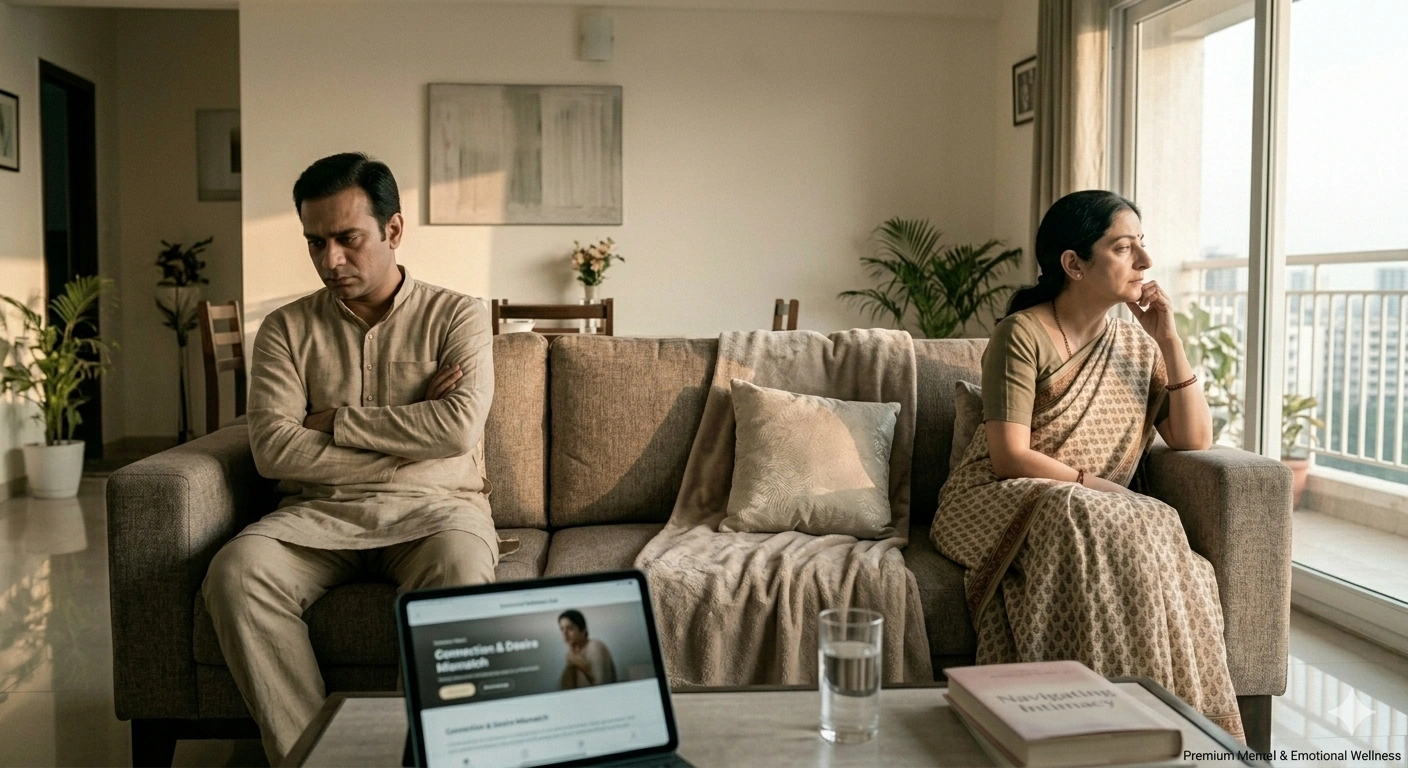
One of you wants it. The other doesn't. The lights go off, both of you turn to your phones, and another night ends in the same quiet rejection. Neither of you says anything. Both of you feel the gap widening.
This is the dynamic that brings most couples into Low Libido Counselling Couples India sessions — not the sex itself, but the slow erosion of closeness that comes with desire mismatch. By the time a couple books a session, it's rarely about libido alone. It's about everything libido has been damaging in the background.
Most Indian couples can talk about money, in-laws, children, and household chores. The one thing they can't discuss is the bedroom.
So the higher-desire partner builds resentment in silence. The lower-desire partner carries guilt in silence. Both pretend everything is fine until "fine" becomes the most loaded word in the house.
Therapy creates the conversation that the bedroom and kitchen never could. With a third person holding space, both partners finally get to say the parts they've been swallowing.
Mismatched sexual desire isn't a sign that something's wrong with one partner. It's a normal pattern in most long-term relationships. The problem isn't the difference — it's how the couple handles the difference.
Some couples decide the lower-desire partner is "the issue" and try to fix them. Others stop trying altogether. Both routes lead to the same place: emotional distance dressed up as practical compromise.
A desire gap becomes a marriage-level issue only when both partners stop talking about it openly. The silence is the damage. The mismatch itself is just data.
Read More: Body Image Issues and Impact on Intimacy
_1779346283.webp)
Without intervention, intimacy problems in marriage almost always grow. They rarely shrink on their own.
A few patterns therapists see often:
One partner mentally tracking every rejection or pursuit, building a quiet case.
Staying up late, scrolling, anything to skip the bedtime overlap.
Being extra polite at dinner to compensate for what isn't happening at night.
Both partners stop initiating because the rejection cycle feels too heavy.
These intimacy problems in marriage feel manageable in month one. By year two, they've quietly reshaped the entire relationship.
The longer this goes on without conversation, the harder the unwinding becomes. Couples who reach therapy after five or more years of unspoken mismatch take longer to rebuild — not because the issue is bigger, but because both partners have learned to live around each other rather than with each other.
A session isn't an interrogation. It's a structured conversation neither partner could manage alone.
A typical flow looks like this:
Couples intimacy therapy delivered this way doesn't push one partner to want more or the other to want less. It teaches both to navigate the gap without resentment building underneath.
Sex counselling online sometimes starts with the higher-desire partner attending alone. That's a fine opening — but the work only goes deep when both partners are present.
A solo session can clarify your needs. A joint session changes what your partner actually hears. Most low-desire partners spend years assuming their partner is angry or unhappy with them, when the real feeling underneath is loneliness or worry.
Counselling tips for a healthy sexual life work much better when both partners learn them together — not when one becomes the project manager of the other's libido.
Walking into a sex therapist's clinic still feels like a public statement in most Indian cities. Online sessions remove the visibility issue completely.
According to Gallup's long-running research on marriage and wellbeing, couples who address relationship distress earlier report higher long-term satisfaction — but stigma often delays seeking help. Online therapy cuts that delay dramatically.
A couple in Mumbai, Bengaluru, or Patna can sit on the same sofa, log in through one screen, and access the same quality of therapist they'd find in any major city. Sex counselling online has flattened the access problem in ways that the in-person clinic model never could.
Online sessions also work well for couples in joint families, where booking a clinic visit means explaining absences to parents, in-laws, or curious siblings. The screen offers a privacy that an Indian home rarely does.
Read More: How to Keep Passion Alive in a Long-Term Marriage
Real reconnection doesn't look like a sudden libido surge. It looks like a return of small things both partners stopped doing — eye contact at dinner, a hand on the back while walking past, a real laugh that doesn't feel performed.
Emotional closeness in relationships rebuilds before physical closeness does. Couples who go through sustained couples intimacy therapy report that the bedroom shifts only after the daytime warmth returns. Skip the warmth and the bedroom stays cold.
Different types of touch that build closeness become useful once both partners feel safe again. The order matters: emotional closeness in relationships first, physical intimacy second. Most couples try it backwards and wonder why nothing works.
Most couples seeking Low Libido Counselling Couples India support aren't asking a therapist to fix one person's desire. They're asking for a way to feel close again without the bedroom turning into a scoreboard.
If the rejection-cycle feels familiar, the smart move is to book a joint session before resentment becomes the dominant emotion in the marriage. Desire mismatches are normal. The damage they cause when ignored is not. A few honest conversations with a trained therapist can shift years of buried frustration faster than most couples expect, especially when both partners commit to the work between sessions.
Extremely common, though rarely discussed. Most long-term couples experience desire shifts at different points, especially around career transitions, parenting, and health changes.
No, a trained couples therapist works with both experiences equally and avoids framing one partner as the problem.
Often yes, though hormonal, medication-related, and lifestyle factors should always get ruled out alongside therapy.
Most see meaningful shifts within eight to twelve sessions, depending on how long the issue has built up.
Start solo. A skilled therapist can shift the home dynamic enough that your partner often becomes curious about joining later.

Online
English, Punjabi, Haryanvi
Couple Counseling, Marital Counselling, LGBTQ, Addiction, Depression

It's 7pm. You've been making decisions since you woke up , wh...
 27 Jun 2026 6 min Read 1.1k Reads
Think about the last time a conversation with someone you love went wrong. ...
26 Jun 2026 6 min Read 1.1k Reads 
Nobody told you your childhood was hard. That's part of the probl...
24 Jun 2026 6 min Read 1.5k Reads 
You can be surrounded by people and still feel completely alone. Most...
23 Jun 2026 6 min Read 880 Reads 
Area Of Expertise : Couple Counseling, Marital Counselling, LGBTQ, Addiction, Depression, Family Counseling, Relationship Counselling, Anger Management, Sexual Wellness, Marriage & Couple Counselling
Book a Session
Better mental health at your convince
