


Package of 5 Sessions
- Rs.5,999.00/-
digital detox for mental health benefits are real , but detoxing without a plan rarely sticks. Here's what it does to your brain and a practical action plan that actually holds.
 Dr. Neha Mehta
  20 Jun 2026
  Mental Health
  530 Reads
  8 min Read
Your phone is the last thing you look at before sleep and the first thing you reach for when you wake. Somewhere in between, it's with you through every meal, every commute, every quiet moment that doesn't stay quiet for long.
And you already know this isn't great.
digital detox for mental health , the deliberate reduction of screen time to let the mind genuinely recover , is one of those things most people know they need but don't quite know how to do, or keep trying in ways that don't stick.
This isn't a lecture about phones. It's a breakdown of what constant connectivity actually costs your mental health, what the research says about disconnecting, and an action plan that's usable in real life.
A digital detox for mental health practice isn't just putting your phone in another room for a weekend. It's the deliberate reduction of passive, draining digital consumption , notifications, news feeds, and endless scrolling , to give the nervous system actual recovery time.
The distinction matters. Productive technology use , creating, working, connecting meaningfully , affects the brain differently than passive consumption , scrolling, absorbing, reacting. A digital detox for mental health targets the second category. Not technology broadly, but the constant low-grade stimulation that keeps the brain in a state of perpetual partial attention.
Screen time and mental health research consistently shows it's not just duration that causes harm , it's the passive, reactive nature of most screen time. You're not directing your attention. Your attention is being continuously captured and handed back to you pre-occupied.
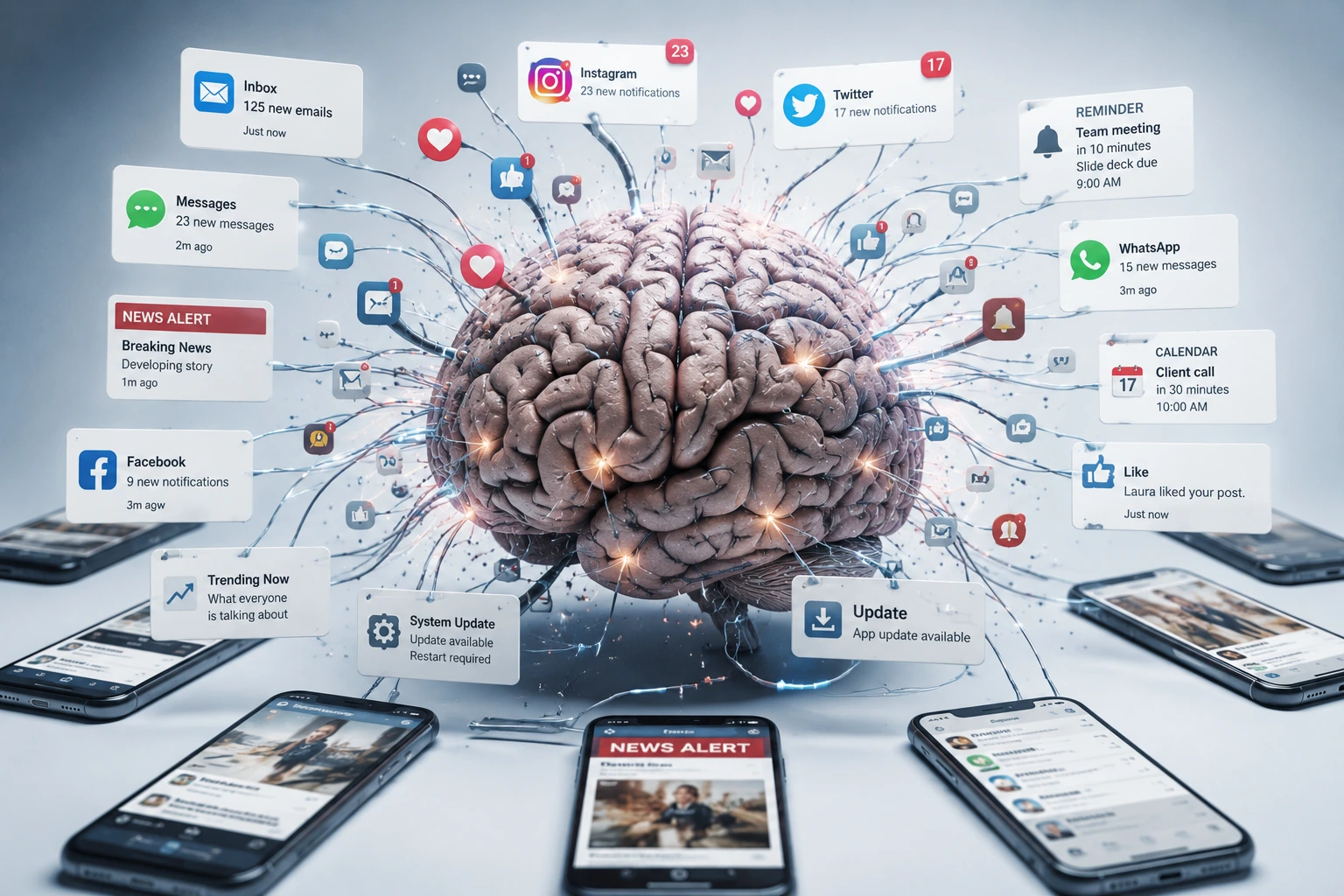
The brain wasn't designed for this volume of input. It evolved to process the social information of a village, not a feed of millions.
What accumulates over time:
The compounding effect of all of these together , not dramatically, just quietly, over months , is what makes screen time and mental health a legitimate concern rather than a generational moral panic.
Yes , and the research says so directly enough to state it clearly.
A University of Pennsylvania study found that limiting social media to 30 minutes a day produced significant reductions in loneliness and depression over three weeks , compared to a control group that made no change. Not quitting entirely. Just reducing. The effect was real regardless.
What people consistently report after a genuine detox period:
Most people feel a shift within 72 hours. Which is where the brain reset concept becomes relevant.
What a detox is not good for: treating underlying anxiety, depression, or anything that was already there before the phone became central. If digital detox for mental health benefits don't last past a few days of returning to normal usage , the screens were amplifying something that needs more direct attention.
The 72 hour brain reset refers to the observed phenomenon that roughly 72 hours of significantly reduced screen time produces a measurable shift in mental clarity, mood, and baseline anxiety.
The mechanism is neurological. Dopamine-driven stimulation from screens keeps reward pathways in continuous low-level activation. When that stimulation is removed, the brain recalibrates over approximately three days , the fog lifts, background noise quiets, and the ability to experience ordinary moments without immediately reaching for something to fill them returns.
The 72 hour reset isn't a cure. It's a demonstration , direct proof of what the baseline feels like without the noise. Most people find it more convincing than anything they've read because they feel the contrast themselves.
Most people underestimate how much screen time and mental health are linked until a real break shows them the difference.
Signs worth paying attention to:
The damage from constant connectivity is quiet and cumulative. Most people don't act on it until a deliberate break reveals the contrast.

Not "delete everything and go meditate." Practical, sustainable steps.
Start with an audit. Before making changes, spend two days noting how many times you pick up your phone and what you were feeling before you did. Bored? Anxious? Avoiding something? The audit reveals the function the phone is serving , which matters for what you actually replace it with.
A plan that holds:
For the 72 hour reset: remove social media apps from your phone for three days , not the accounts, just the apps. Redownloading takes enough friction to interrupt automatic behaviour. These are mental health tips that cost nothing and compound when maintained.
My Fit Brain works with people where mental exhaustion and stress and anxiety have crossed from something a detox can address into a persistent baseline. digital detox for mental health work is a meaningful first step , but sometimes what surfaces when the noise stops needs actual support to process.
The detox addresses the amplifier. Not what's being amplified.
If social media anxiety, stress and anxiety, or mental exhaustion return to the same level within days of resuming normal usage , the screens were making something worse that was already there. The detox gave relief. The underlying pattern needs more direct attention.
Mindfulness and mental health practices help. digital detox for mental health changes help. But if the baseline keeps returning regardless of what you change on the surface , that's the signal. Not that you failed. That the thing underneath is asking to be looked at properly.
digital detox for mental health work is one of the simplest, highest-leverage things available. No money, no diagnosis, no dramatic lifestyle change , just deliberate reduction and the willingness to sit with what surfaces when the noise stops.
Most people are surprised by how quickly it shifts things. Most people are also surprised by what they were using the noise to avoid.
Both pieces of information matter. Start with the 72 hours. See what your baseline actually feels like without the feed. That's usually where it gets real.
If reducing screen time keeps revealing the same underlying anxiety or exhaustion , a single session with a qualified therapist can help you understand what's actually driving it.
Single Session , ₹550+. No commitment. Just a start. From your phone, 100% confidential.
Five that are consistently evidence-backed:
A mental health detox , particularly digital detox for mental health practice , is a deliberate period of reduced exposure to stimuli that are draining the nervous system: screens, news, social media, constant notifications. The goal is to allow the brain's baseline stress and anxiety levels to reset and genuine cognitive and emotional recovery to happen.
For a meaningful reset, 72 hours is the minimum that produces a noticeable neurological shift. A week produces deeper changes in sleep, mood, and attention. Permanent lifestyle adjustments , reduced notification access, morning screen-free blocks , are more sustainable than periodic full detoxes and produce more lasting mindfulness and mental health benefits.
Research says yes , particularly passive use. Social media anxiety from comparison, the dopamine loop of variable reward, and the mental exhaustion of continuous stimulation all contribute to elevated anxiety and depression symptoms. The University of Pennsylvania study found significant mood improvement from just 30 minutes of daily social media , not quitting entirely, just reducing.
Not on its own , and it's important to be honest about this. digital detox for mental health benefits are real but require ongoing maintenance, not a one-time reset. More importantly, a detox addresses amplifiers not roots. If anxiety or mental exhaustion persist after consistent reduction in screen time, the underlying pattern needs direct support , which is where mental health tips alone reach their ceiling.

Online
English, Punjabi, Haryanvi
Couple Counseling, Marital Counselling, LGBTQ, Addiction, Depression

It's 7pm. You've been making decisions since you woke up , wh...
 27 Jun 2026 8 min Read 1k Reads
Think about the last time a conversation with someone you love went wrong. ...
26 Jun 2026 8 min Read 1k Reads 
Nobody told you your childhood was hard. That's part of the probl...
24 Jun 2026 8 min Read 1.4k Reads 
You can be surrounded by people and still feel completely alone. Most...
23 Jun 2026 8 min Read 817 Reads 
Area Of Expertise : Couple Counseling, Marital Counselling, LGBTQ, Addiction, Depression, Family Counseling, Relationship Counselling, Anger Management, Sexual Wellness, Marriage & Couple Counselling
Book a Session
Better mental health at your convince
