


Package of 5 Sessions
- Rs.5,999.00/-
Doomscrolling and mental health damage is real, and it's not just about willpower. Here's what it's actually doing to your brain
 Dr. Neha Mehta
  17 Jun 2026
  Mental Health
  677 Reads
  8 min Read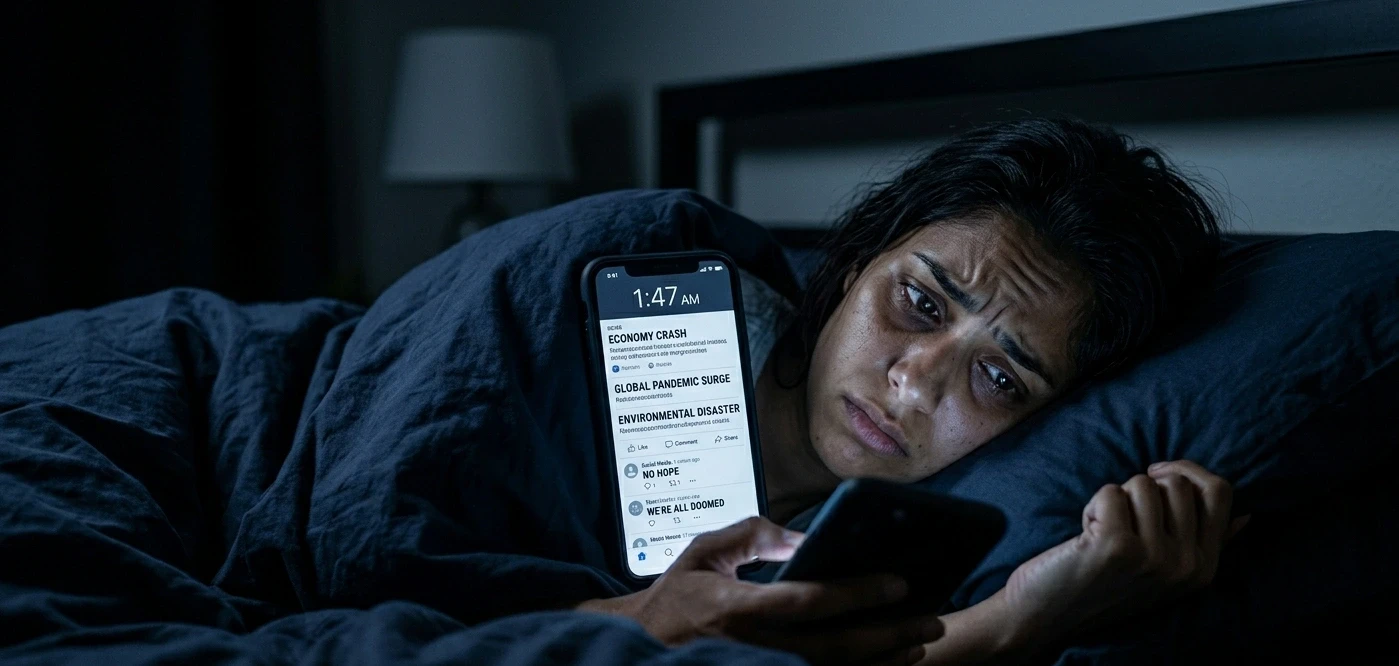
You pick up your phone for two minutes. Forty-five minutes later you're reading about something terrible happening somewhere, and you feel worse than before you started, but you don't stop.
That's doomscrolling. And if you're doing it regularly, you already know something's off. You just can't quite name what it's doing to you, or why the phone always wins.
Here's the direct answer: doomscrolling and mental health effects are cumulative and real. It isn't just a bad habit. It's a compulsive loop that keeps your nervous system in a low-grade stress state, anxious, overstimulated, and unable to properly rest, even long after the screen is off. Sleep suffers. Mood suffers. The ability to feel calm in an ordinary moment suffers.
This is what's happening inside your brain when you doomscroll, why stopping is genuinely hard, and what actually works.
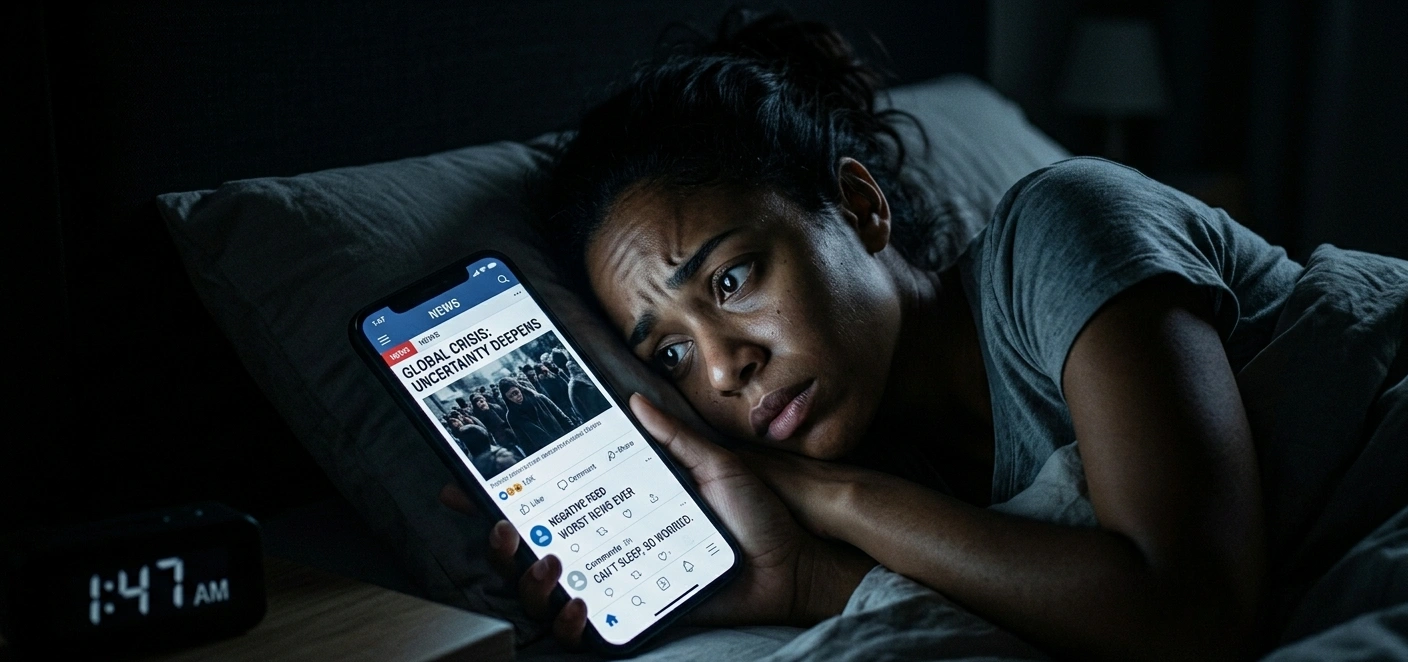
Doomscrolling is the compulsive consumption of negative news and upsetting content online, even when it's making you feel worse. It spiked during COVID, but it didn't go away. If anything, it became wired into how many people now relate to their phones.
It's not about being uninformed or caring too much about the world. The behaviour itself is the problem, the inability to stop, the pull back to the feed even after you've closed it, the low hum of unease it leaves behind.
Screen time and mental health research consistently shows that passive, negative content consumption, scrolling without interacting, absorbing without acting, is particularly damaging compared to active or social uses of technology. You're not connecting. You're not creating. You're just absorbing, in a loop, with no off switch in sight.
Read More: High-Functioning Anxiety: Signs, Symptoms & How to Cope
The short version: it keeps your brain in threat-detection mode. And threat-detection mode was never designed to run all day.
When you scroll through upsetting content, your brain responds to it as it would any perceived threat, activating a mild but persistent stress response. Cortisol rises slightly. Attention narrows. The nervous system braces. Under normal circumstances this resolves when the threat passes. But when you keep scrolling, the threat never passes.
The feed is infinite. The stress response just keeps running.
Over time, regular doomscrolling and mental health damage accumulates like this:
Here's the part that explains why willpower alone doesn't fix this. Doomscrolling activates the same neurological loop as other compulsive behaviours, dopamine-driven variable reward. Every scroll is a small gamble: the next thing might be important, might be useful, might resolve the anxiety. Occasionally it does.
That unpredictable payoff is what makes the behaviour so hard to interrupt.
Anxiety and overthinking feed directly into this loop. The anxious brain craves information because information feels like control. Doomscrolling looks like staying informed. It feels like managing uncertainty. It's actually neither, but the nervous system doesn't know that, and it keeps reaching for the phone anyway.

Some of these are obvious. Some aren't.
If the less obvious list hit harder than the obvious one, that's worth noticing. Doomscrolling and mental health effects are often most damaging in the ways that are hardest to attribute directly to the phone.
Because "just stop" isn't how compulsive behaviour works. And because the reasons you doomscroll in the first place don't go away when you put the phone down.
Most people doomscroll for one of a few reasons, and none of them are stupidity or weakness:
According to research from the American Psychological Association, people who frequently check social media report significantly higher stress and anxiety than those who don't, but they also report more difficulty disconnecting. The loop sustains itself.
Understanding why you scroll matters because digital detox advice that ignores the why almost always fails. You can delete the apps and still be back in the same pattern within two weeks.
Not willpower tips. Things that actually work.
My Fit Brain works with people whose screen time and mental health have started feeding into broader social media anxiety and anxiety and overthinking patterns, where the doomscrolling is a symptom of something running underneath. Understanding that layer changes what recovery actually looks like.
Some people can implement the practical strategies above and things genuinely shift. The scrolling reduces. The baseline anxiety softens. Sleep improves.
And some people can't. Not because they're weak, because what's driving the doomscrolling is bigger than the habit itself.
If your doomscrolling and mental health spiral is rooted in underlying stress and anxiety, social media anxiety that maps onto real social fears, or an anxiety and overthinking pattern that was there long before the phone, the habit interventions are surface level. They treat the symptom without touching what's underneath.
That's when mental health tips and self-help have a ceiling, and talking to a qualified therapist starts to matter. Not to be told to put your phone down, you know that already. But to understand what the phone is doing for you, what it's helping you avoid, and what addressing that actually looks like.
Doomscrolling and mental health damage accumulates quietly. But so does recovery, when it's pointed in the right direction.
Doomscrolling and mental health damage is real, cumulative, and vastly underestimated, because it doesn't look like a crisis. It just looks like being on your phone.
But the low-level anxiety it feeds, the sleep it disrupts, the presence it steals from your actual life, that adds up. Quietly, consistently, in ways you feel but can't always name.
Putting the phone down is the start. Understanding why you picked it up in the first place is the work.
If doomscrolling has become the automatic response to anxiety, silence, or discomfort, a few sessions with a qualified therapist can help you understand what's actually driving it.
The Transformation, 10 sessions at ₹9,999. Same therapist, 30 minutes each, from your phone. 100% confidential. Therapist assigned within 48–72 hours.
Doomscrolling mental health effects include elevated baseline anxiety, disrupted sleep, emotional blunting, and reduced attention span. The brain stays in a low-grade stress state from continuous threat-detection, which doesn't switch off when you put the phone down.
Because it's a dopamine-driven compulsive loop, the same mechanism behind other hard-to-break habits. Every scroll is a small gamble that the next thing might resolve your anxiety or feel important. That unpredictable payoff keeps you coming back.
It's not a weakness. It's neuroscience, and knowing that is the first step to addressing it differently.
The content keeps the brain in threat-detection mode, making it genuinely hard to wind down. Beyond blue light, the emotional load of what you've consumed sits in the nervous system and continues processing, which is why many people lie awake thinking about things they read hours earlier.
Not exactly, but they feed each other. Anxiety and overthinking make doomscrolling more likely because the anxious brain craves information as a proxy for control. And doomscrolling amplifies social media anxiety and baseline stress levels, making the underlying anxiety worse. It's a loop, not a cause-and-effect in one direction.
It can, but only if it addresses why you were scrolling in the first place. A digital detox that simply removes access without replacing the function the scrolling was serving rarely sticks longer than two weeks. The more effective approach is understanding the trigger and building a different response to it, not just eliminating the outlet.

Online
English, Punjabi, Haryanvi
Couple Counseling, Marital Counselling, LGBTQ, Addiction, Depression
It's 7pm. You've been making decisions since you woke up , wh...
 27 Jun 2026 8 min Read 1.1k Reads
Think about the last time a conversation with someone you love went wrong. ...
26 Jun 2026 8 min Read 1.1k Reads 
Nobody told you your childhood was hard. That's part of the probl...
24 Jun 2026 8 min Read 1.5k Reads 
You can be surrounded by people and still feel completely alone. Most...
23 Jun 2026 8 min Read 873 Reads 
Area Of Expertise : Couple Counseling, Marital Counselling, LGBTQ, Addiction, Depression, Family Counseling, Relationship Counselling, Anger Management, Sexual Wellness, Marriage & Couple Counselling
Book a Session
Better mental health at your convince
