


Package of 5 Sessions
- Rs.5,999.00/-
You show up. You perform. But high functioning anxiety is quietly exhausting you from the inside. Here's how to recognize the signs and what actually helps.
 Dr. Neha Mehta
  12 Jun 2026
  Anxiety
  749 Reads
  9 min Read
You're not falling apart. That's actually the problem.
You show up to work on time. Hit your deadlines. Respond to messages, attend the calls, smile in the right places. From the outside, everything looks fine , maybe even impressive. But inside there's this low hum.
A quiet, persistent noise that doesn't switch off even when the day does. Something exhausting that you can't fully name, can't fully shake, can't explain to anyone without sounding ungrateful.
That's high functioning anxiety. And it might be the most overlooked emotional struggle today , precisely because the people carrying it are too busy holding everything together to stop and notice it's slowly costing them everything.
Here's what it actually looks like, why it stays invisible for so long, and what you can do about it.
High functioning anxiety isn't an official clinical diagnosis. It won't show up in any psychiatric manual. But that doesn't make it any less real.
It describes a pattern , a way of living where anxiety symptoms are present, sometimes intense, but the person manages to function anyway. Perform, even. The anxiety becomes the fuel. It drives productivity, perfectionism, and "just one more task before I sleep."
From the outside, it looks like ambition. From the inside, it feels like running from something that's always just behind you.
Most people with this pattern don't seek help because they don't feel they've earned the right to struggle. "I'm not bad enough." "Others have it worse." So they keep going. And the stress and anxiety quietly accumulates , unaddressed, unprocessed , sometimes for years. There's no dramatic breaking point. Just a slow, grinding exhaustion that people learn to call personality.
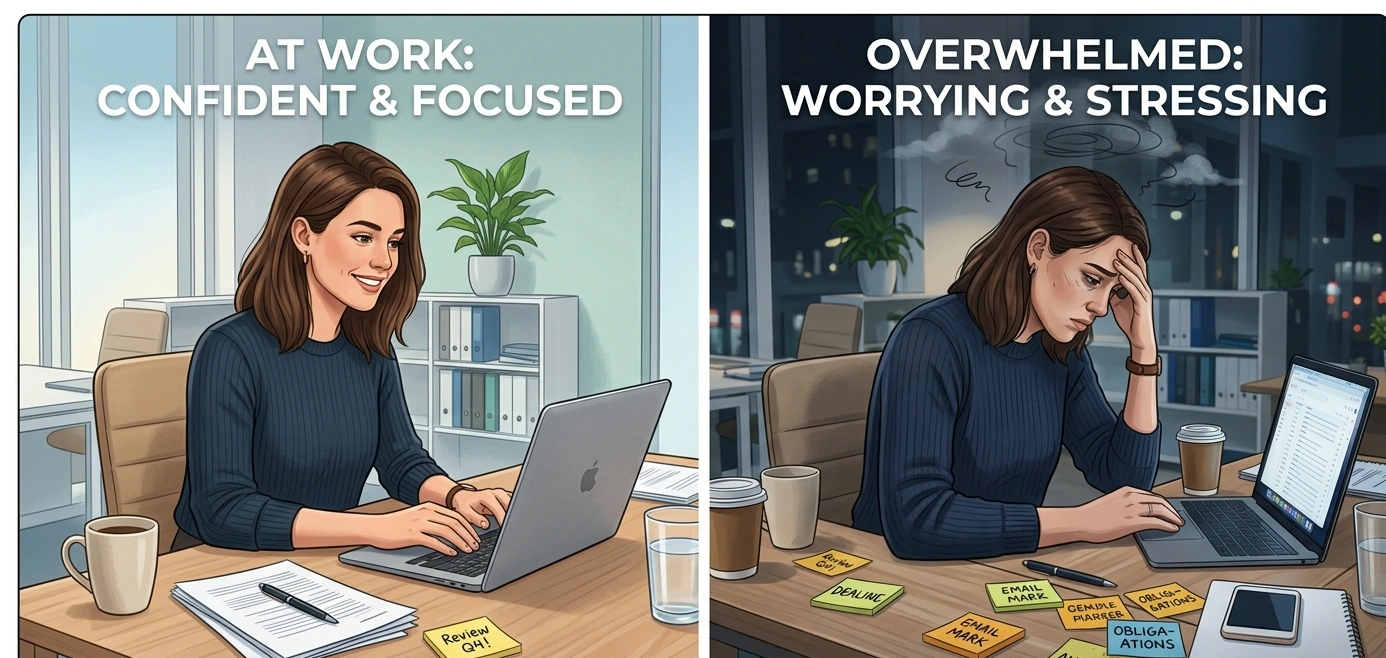
The clearest sign is the gap between how you appear and how you actually feel.
You've probably said "I'm fine" so many times that you've started to half-believe it yourself. Here's what's actually happening underneath:
None of this looks dramatic from the outside. None of it looks like a "real" problem. But living inside it is a different thing altogether , relentless in a way that's hard to explain to anyone who hasn't felt it themselves.
Overthinking is the most constant companion of high-functioning anxiety. Not the productive kind of thinking , the circular kind. Where you've already made the decision, sent the message, handled the thing , but the brain keeps running the scenario anyway. Just to check. Just to be absolutely sure.
It's not always about the big stuff. Sometimes it's an email tone. A friend who seemed slightly off on a call. A comment you made in a meeting three days ago that no one else even registered.
And that level of sustained, relentless mental activity , quiet but constant , starts showing up in the body eventually, whether you notice it or not.
This is where people are often surprised.
Stress and anxiety that stays unprocessed doesn't just stay in your head. The body keeps score. And with high-functioning anxiety, the body often starts signalling distress long before the mind is ready to admit there's a problem.
What it can look like physically:
Burnout often starts looking exactly like this in its early stages. The line between high-functioning anxiety and early burnout is thinner than most people think. Because managing this pattern takes enormous, invisible energy , just to maintain the appearance of calm, just to keep everything running. Over time, those reserves run low.
Because it works. That's the cruelest part.
The anxiety is producing results. Deadlines get met. Performance is solid. The inbox is clean. People are impressed. From the outside , and sometimes from your own perspective too , there's no clear evidence of a problem. So where's the incentive to change anything?
There isn't one. Not until something breaks.
The cultural layer makes it worse, especially here in India. "Sab theek hai" is the default answer to everything. Anxiety is still treated as weakness in many spaces , something you push through, not something you examine.
The idea that you might need mental health counselling for a problem that's invisible, that doesn't even look like a problem to anyone? Feels excessive. Feels self-indulgent, even.
But here's what's true.
The fact that it's invisible doesn't mean it isn't real. The fact that you're coping doesn't mean you're okay. High functioning anxiety often goes unrecognised for years , sometimes decades , because the person experiencing it has become an expert at masking it. Even from themselves.

There's no clean five-step fix. Anyone offering you one isn't being fully honest.
But there are things that genuinely shift the pattern , not as cures, but as ways of creating more space between the anxiety and your reaction to it.
That last one matters more than it sounds. Because here's the thing , most people who would benefit most from support are the ones who feel least entitled to it. The ones who are coping. The ones who look fine. The ones reading articles like this at midnight, quietly recognising themselves in every line.
My Fit Brain was built exactly for this kind of exhaustion , not for people in crisis, not for people falling apart, but for people who are just quietly tired of managing alone. That's what online therapy India is genuinely for.
There's a version of managing high functioning anxiety where the strategies work , you cope better, function smoother, mask it more efficiently. But the anxiety itself doesn't change. The load stays. You just get better at carrying it.
That's the point where talking to a qualified therapist , not just a good friend, not just a self-help resource , starts to really matter.
Mental health counseling for this pattern usually focuses on understanding what created it in the first place: the perfectionism, the people-pleasing, the fear of failure that learned to disguise itself as drive. Then, slowly, building a genuinely different relationship with those patterns.
It's quiet work. But it reaches somewhere that coping strategies can't.
What anxiety symptoms look like after a few consistent months of counselling is different , not necessarily gone, but quieter. Less automatic. More like information you can choose to respond to, rather than commands running in the background without your permission.
According to research from the World Health Organization, anxiety disorders affect 1 in 4 people at some point in their lives , but the vast majority never access any support. The barrier isn't availability anymore. It's the belief that you haven't suffered enough to deserve help.
You have. The bar is much lower than you've been setting it.
High functioning anxiety hides in plain sight , in packed schedules, in late nights, in the strange hollowness after a day that went well but still left something feeling off. It's real, it's common, and it doesn't get better by working harder or performing better or pushing through.
You're allowed to be tired. You're allowed to want something more than just managing. And you don't have to be falling apart for that to be valid.
The first step is usually just admitting , to yourself, honestly , that the hum is there. That it's been there for a while. That it deserves some actual attention.
That's enough to start.
If what you read here felt familiar , the hum, the overthinking, the exhaustion that no one else can see , you don't have to keep carrying it alone.
Our qualified, background-verified therapists work with people exactly like this. Not crisis. Just the quiet, relentless kind of hard. 17,000+ people have already taken that first step.
High functioning anxiety describes a pattern where persistent anxiety symptoms are present but the person continues to function , often high-performing , while hiding how exhausted they feel inside. It's not an official diagnosis, but it's very real. Key signs include:
Yes , and that's exactly what makes high-functioning anxiety so hard to catch. The anxiety often fuels productivity, making it feel like a feature rather than a problem. Over time though, it quietly depletes the nervous system and leads to burnout.
The body often signals it before the mind does. Common physical signs include:
Stress is usually tied to a specific situation and fades once it's resolved. High functioning anxiety is more constant , a background state that persists even when things are objectively fine. It's less "I'm stressed about this deadline" and more "I'm always waiting for something to go wrong."
Absolutely , and it works particularly well for this pattern because sessions are private, flexible, and accessible from your phone. Many people find it easier to open up when there's no commute, no waiting room, no one who might see you walk in. Online therapy India has made quality support far more accessible than it used to be

Online
English, Punjabi, Haryanvi
Couple Counseling, Marital Counselling, LGBTQ, Addiction, Depression

It's 7pm. You've been making decisions since you woke up , wh...
 27 Jun 2026 9 min Read 1.1k Reads
Think about the last time a conversation with someone you love went wrong. ...
26 Jun 2026 9 min Read 1.1k Reads 
Nobody told you your childhood was hard. That's part of the probl...
24 Jun 2026 9 min Read 1.5k Reads 
You can be surrounded by people and still feel completely alone. Most...
23 Jun 2026 9 min Read 874 Reads 
Area Of Expertise : Couple Counseling, Marital Counselling, LGBTQ, Addiction, Depression, Family Counseling, Relationship Counselling, Anger Management, Sexual Wellness, Marriage & Couple Counselling
Book a Session
Better mental health at your convince
