


Package of 5 Sessions
- Rs.5,999.00/-
Self sabotage psychology isn't weakness, it's protection that stopped working. Here's what's actually driving it, how to spot it,
 Dr. Neha Mehta
  18 Jun 2026
  Mental Health
  657 Reads
  9 min Read
You had the opportunity. You were ready. And then somehow, you weren't.
You didn't prepare when you should have. You said the thing that pushed the person away. You waited too long, second-guessed too much, or found a reason it wouldn't work right at the moment it almost did. And now you're sitting with the familiar feeling of having gotten in your own way. Again.
This is self-sabotage psychology. And the hardest part isn't the behaviour itself, it's that the person doing the sabotaging usually knows, somewhere underneath, exactly what they're doing. And still can't stop.
Self-sabotage is not random and it is not a character flaw. It's a protection mechanism that outlived its usefulness. Understanding why it happens, the actual reasons, not the surface ones, is where the pattern finally starts to shift.

Self-sabotage is any pattern of thinking or behaviour that consistently undermines your own goals, relationships, or wellbeing, often without fully conscious intent.
It's not the same as making mistakes. Everybody makes mistakes. Self-sabotage psychology specifically describes the pattern where the obstacle to your progress is reliably you. Where the thing standing between you and what you want is something you're generating, often right at the moment it would matter most.
Procrastinating on the project that actually counts. Picking a fight when the relationship is finally going well. Underperforming in the interview you genuinely prepared for. Cancelling the plans that were important. Going back to the habit you'd just broken.
The common thread isn't the specific behaviour, it's the timing. It happens precisely when something good is within reach. That is not a coincidence. That's self-destructive behaviour with an internal logic to it, even when it looks completely irrational from the outside.
Read More: Attachment Styles in Relationships: Secure, Anxious & Avoidant
Most people assume self-sabotage is about weakness. Or not wanting things badly enough. Or some vague personal failing that more discipline would fix.
It isn't any of those things. Self-sabotage psychology research consistently points to a few specific mechanisms, and they have nothing to do with motivation.
Fear of failure is the obvious one. If you don't fully try, you can't fully fail. Pulling back before something matters most protects you from experiencing the full weight of not succeeding. The incomplete attempt carries less sting than the complete one that didn't work.
But the less-discussed version is fear of failure's quieter sibling, fear of success. And it's equally real. Success brings visibility, expectation, the pressure of maintaining what you've built, the risk of losing it once you have it. For a nervous system wired to anticipate threat, success can feel as dangerous as failure. So it gets quietly undermined before it fully arrives.
Low self-worth creates an internal ceiling, often completely unconscious, of what you deserve, what's realistic for someone like you, what kinds of good things are actually meant for you versus other people.
When something exceeds that ceiling, a relationship that's genuinely kind and consistent, a job that actually excites you, a version of your life that looks better than you expected, the nervous system gets uncomfortable. Self-destructive behaviour kicks in to bring reality back in line with what you believe about yourself.
"I'll mess this up eventually anyway." The sabotage just makes it happen on your own terms, in a way you can partially control. There's a grim logic to it.
Anxiety and overthinking that traces back to old experiences, a relationship that ended in a way that left a mark, a failure that landed harder than expected, a version of yourself you haven't fully made peace with, can quietly run patterns in the present without you making the connection.
The brain pattern-matches. A situation that resembles something that once hurt triggers the same response, avoidance, withdrawal, underperformance, even when the current situation is completely different. You're not responding to what's in front of you. You're responding to what it reminds you of.
Read More: High-Functioning Anxiety: Signs, Symptoms & How to Cope
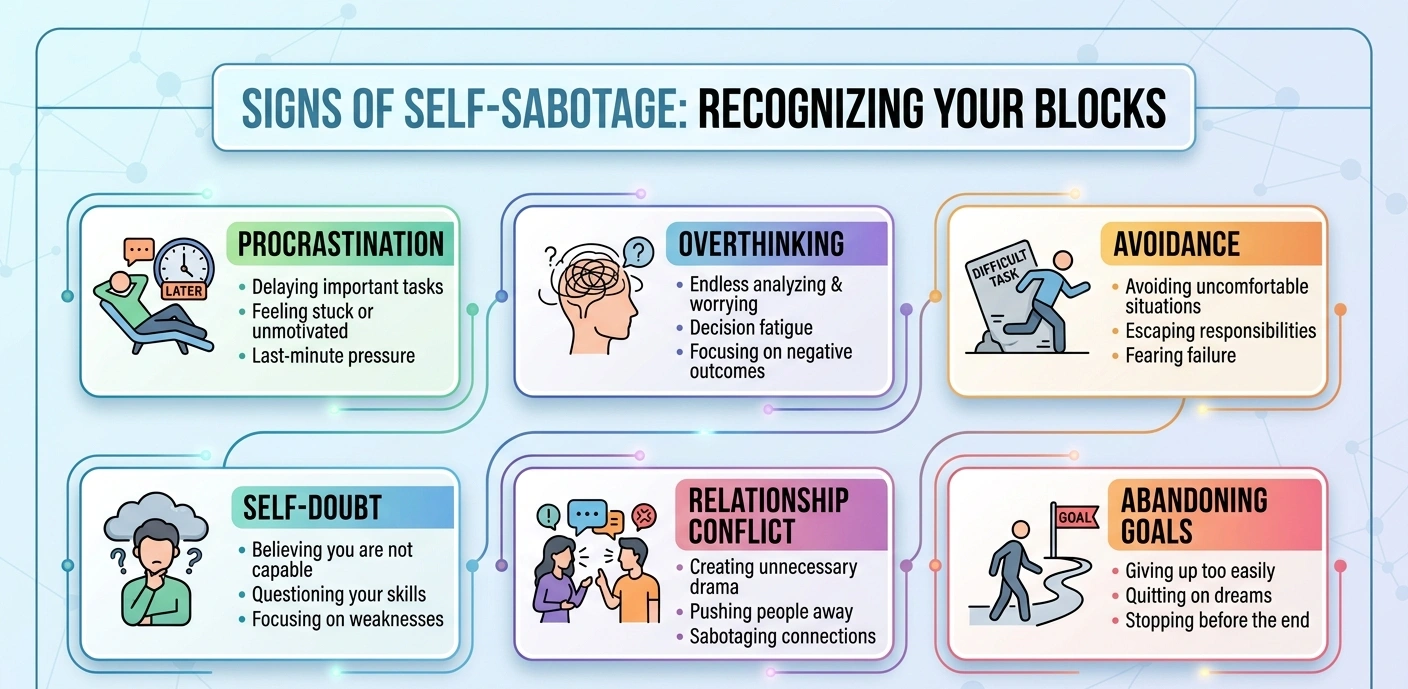
The obvious signs of self-sabotage, procrastination, picking fights, cancelling things, are easy enough to spot in hindsight. These ones are harder.
The pattern of when it happens is the clearest signal. Self-sabotage psychology is not random. It's consistent. And it almost always peaks at the threshold of something that matters.
Read More: Emotional Exhaustion vs Burnout: Symptoms & Recovery Guide
Knowing you self-sabotage is not the same as stopping it. Most people who recognise self-destructive behaviour in themselves already knew, at some level, what they were doing while they were doing it. Awareness alone doesn't break the pattern. Here's what does.
Find what it's protecting. Every act of self-sabotage is protecting something. Before you can change the behaviour, you need to understand what it's guarding against. Fear of failure? Visibility? Exceeding the ceiling of what you believe you're allowed to have?
Sit honestly with this: What does pulling back keep me safe from? The answer, if you sit with it long enough to get past the first few, is where the real work lives.
Catch it in the moment, not in hindsight. Most people recognise self-sabotage after it has already happened. The goal is to catch it as it's forming, the moment the urge to withdraw, bail, or create conflict appears. What are you feeling right before the behaviour? That emotional state is the trigger, and the trigger is the access point.
Learn to tolerate things going well. This sounds strange but it's important. For people whose nervous system associates good things with incoming loss or impossible pressure, stability itself is uncomfortable. It produces an itch to disrupt. Practice sitting with things going well, without immediately scanning for why it won't last or finding a way to make it end on your own terms.
Stop processing it alone. There's a ceiling to what self-awareness can do without support. My Fit Brain works with people at exactly this point, people who see the pattern clearly, who are exhausted from watching themselves get in their own way, who need something more than insight to actually shift. Mental health counselling focused on self-sabotage psychology helps trace the pattern back to its root, the low self-worth, the fear of failure, the old experience still running the show, and build responses that actually hold in real life.
According to Psychology Today, self-sabotage is deeply connected to core beliefs about the self, which means surface-level habit changes have limited impact without addressing those beliefs directly.
Read More: How Low Libido Counselling Couples India Helps Partners Reconnect Emotionally
If you can identify the self-sabotage, understand where it comes from, make a plan, and then watch yourself do it anyway, that is the signal. This has moved beyond what understanding alone can fix.
Self-sabotage psychology that shows up consistently across multiple areas of life, relationships, work, health, creative projects, usually has a shared root. One specific belief about worth, one specific fear of failure, one experience that lodged somewhere and keeps running the same response across every new situation that resembles it.
A qualified therapist helps you find that root. Not by excavating everything painful at once, but by tracing the current pattern backwards until the logic of it becomes visible. And once the logic is clear, once you understand why this behaviour made sense in the context it formed, you have an actual choice about whether to keep using it in a context where it's costing you.
Signs of self-sabotage that are affecting your relationships, your work, or your sense of self respond well to consistent support. The low self-worth underneath them, the anxiety driving it, these are workable. They take time and they take honesty. But they change.
Self-sabotage psychology is not a personal failing. It is a protection mechanism your nervous system developed for real reasons, in a context that no longer exists, now running in situations where it works against you instead of for you.
Understanding that doesn't excuse the behaviour. You still have to do the work of changing it. But it changes the tone of that work, from self-criticism to curiosity. From why am I like this to what is this still trying to protect me from.
That shift in question is where things start to actually move.
If the pattern is clear but you keep repeating it anyway, talking to a qualified therapist can help you get to what's actually underneath it.
The Transformation, 10 sessions at ₹9,999. Same therapist throughout, 30 minutes each, from your phone. 100% confidential.
In self-sabotage psychology, self-sabotage describes patterns of thought or behaviour that consistently undermine your own goals or relationships, usually driven by unconscious fears, low self-worth, or unresolved past experiences. It's not deliberate failure. It's a protection mechanism that formed in a different context and keeps running in situations where it no longer fits.
The clearest signs include:
The main causes in self-sabotage psychology are fear of failure (and sometimes fear of success), low self-worth creating an unconscious ceiling on what you allow yourself to have, and old experiences whose emotional patterns are still running in the present. It's not weakness, it's a nervous system responding to perceived threat.
Yes, closely. Anxiety and overthinking often drive self-destructive behaviour, the anxious brain pulls back from things that feel risky, uncertain, or too good to be trusted. Self-sabotage can be the behavioural expression of that anxiety: removing yourself from a situation before it can hurt you.
Start by noticing when the urge to create distance or conflict appears, specifically whether it correlates with things going well or getting deeper. Then ask what that pull is protecting you from. Doing this honestly, consistently, and ideally with a qualified therapist, is what shifts the pattern over time rather than just interrupting it temporarily.

Online
English, Punjabi, Haryanvi
Couple Counseling, Marital Counselling, LGBTQ, Addiction, Depression

It's 7pm. You've been making decisions since you woke up , wh...
 27 Jun 2026 9 min Read 1.1k Reads
Think about the last time a conversation with someone you love went wrong. ...
26 Jun 2026 9 min Read 1.1k Reads 
Nobody told you your childhood was hard. That's part of the probl...
24 Jun 2026 9 min Read 1.5k Reads 
You can be surrounded by people and still feel completely alone. Most...
23 Jun 2026 9 min Read 879 Reads 
Area Of Expertise : Couple Counseling, Marital Counselling, LGBTQ, Addiction, Depression, Family Counseling, Relationship Counselling, Anger Management, Sexual Wellness, Marriage & Couple Counselling
Book a Session
Better mental health at your convince
