


Package of 5 Sessions
- Rs.5,999.00/-
Attachment styles in relationships quietly shape every connection you have. Here's what secure, anxious & avoidant actually look like, and what
 Dr. Neha Mehta
  15 Jun 2026
  Marriage & Relationship
  625 Reads
  9 min Read
Ever finish a conversation with someone you care about and just think, why did I do that?
Why did you pull away right when you wanted to stay close? Why did you need constant reassurance when you logically knew everything was fine? Why does closeness sometimes feel like a slow pressure building, something to escape before it gets too real?
It's not a character flaw. It's not that you're "bad at relationships." It's usually an attachment.
Attachment styles in relationships describe the emotional patterns we use to connect, seek closeness, and respond to intimacy, patterns that form early in life and quietly run in the background of every relationship we have as adults. They explain the push-pull. The overthinking a text reply. The person who keeps everyone at arm's length and genuinely doesn't know why.
There are three main styles. Here's what each one looks like, how they interact, and what you can actually do with that information.
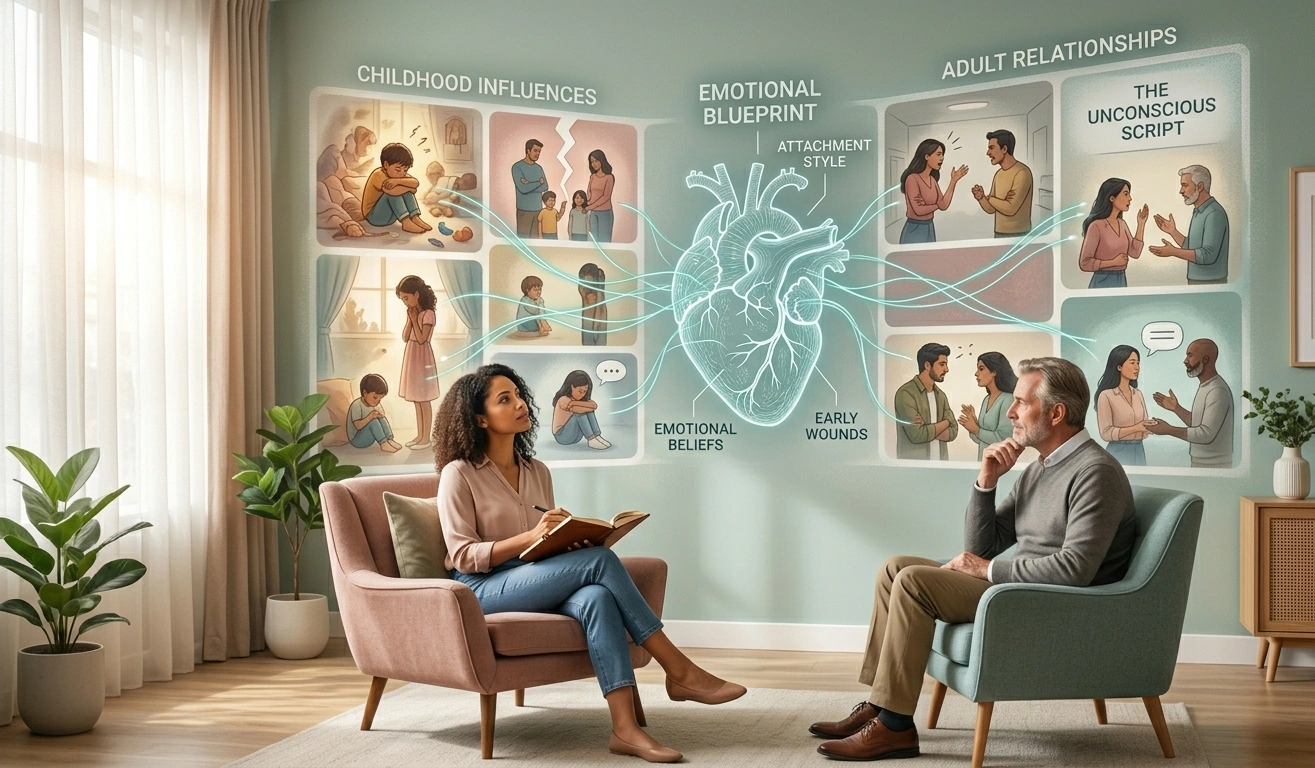
Attachment theory comes from British psychologist John Bowlby and was later expanded by Mary Ainsworth's landmark research in the 1970s. The core idea is simple: the way your early caregivers responded to your needs, consistently, inconsistently, or not at all, gave your nervous system a blueprint for how relationships work.
That blueprint doesn't disappear when you grow up. It moves. Into romantic relationships, friendships, how you handle conflict, how much emotional intimacy you can tolerate before something in you starts looking for the exit.
Understanding attachment styles in relationships isn't about blaming your childhood for everything. It's about understanding the wiring, so you can decide, consciously, what to do with it.
Read More: High-Functioning Anxiety: Signs, Symptoms & How to Cope
The secure attachment style is the baseline most people are working toward. Not because secure people don't struggle, they do, but because they have enough internal stability to navigate struggle without the relationship itself unraveling.
People with a secure attachment style:
Secure attachment doesn't look like someone who never gets anxious or hurt. It looks like someone who can sit with those feelings without letting them take over. Around 50–60% of people have a predominantly secure attachment, though that shifts significantly under stress.
Anxious attachment is the hypervigilant one. The pattern that's always scanning, is everything okay, are we okay, why have they been quiet for three hours.
People with anxious attachment tend to:
The belief running underneath all of this is usually some version of: I am not enough on my own. Eventually, I'll be left. That's not a rational thought. It's a nervous system response that formed before the rational brain was fully developed, and it stuck.
Avoidant attachment is the one that keeps people at a comfortable distance, not out of indifference, but because closeness, at some level, feels genuinely unsafe.
People with avoidant attachment often:
What people miss about avoidant attachment: it's rarely about not caring. It's usually that caring has historically been followed by disappointment, rejection, or being asked for things they couldn't give. So the nervous system learned to stay back. To stay safe by staying just far enough away.
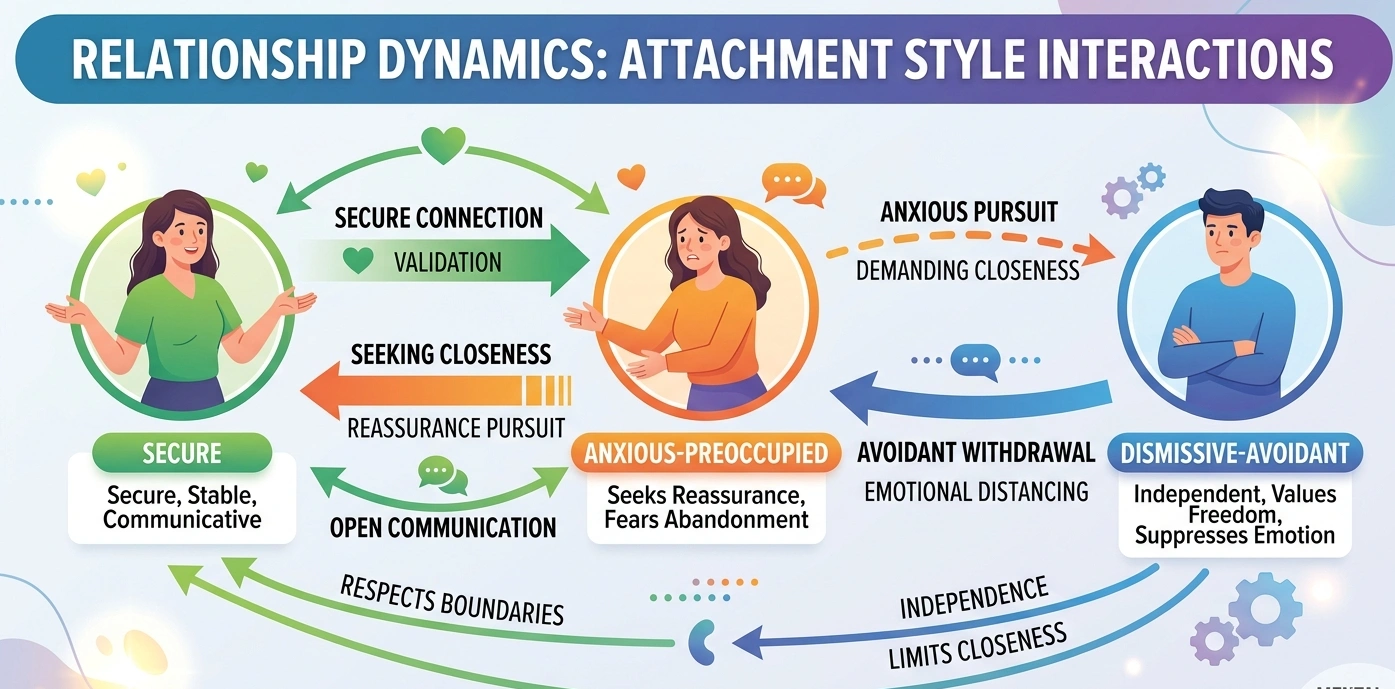
This is where attachment styles in relationships stop being theoretical.
The most common, and most painful, dynamic is anxious and avoidant pairing. The anxious partner pursues. The avoidant partner withdraws. That withdrawal triggers more anxiety. The pursuit triggers more withdrawal.
Neither person is doing anything "wrong" exactly, they're two nervous systems responding to each other in ways that amplify the worst in both patterns.
A few others worth knowing:
Understanding your attachment style doesn't explain everything. But it gives you something concrete to work with instead of just reacting and wondering why you keep ending up in the same place.
Some questions worth sitting with honestly:
No clinical test gives you a clean, definitive answer. But most people, reading the three descriptions above, feel one resonate significantly more than the others. That recognition is worth paying attention to.
Relationship anxiety that keeps surfacing in otherwise good relationships, or the pull to stay emotionally distant despite wanting connection, both usually trace back to attachment patterns. And both respond to the right support.
Read More: Is It Stress or Anxiety? How to Tell the Difference
Yes. And this is important to say clearly, because a lot of people read about anxious or avoidant attachment, recognise themselves completely, and immediately feel stuck with it forever.
That's not how it works.
Attachment styles in relationships are learned patterns, not permanent personality traits. They formed in response to specific conditions and can shift, slowly, with real effort, in response to new ones.
What genuinely creates change:
Reading about attachment styles in relationships gives you language for things that were previously just painful and confusing. That's genuinely useful.
But knowledge alone doesn't change a pattern. You can know you're anxiously attached and still send the message. You can know you're avoidant and still shut down in the middle of the conversation that mattered most. The gap between knowing and doing something different, that's where most people stay stuck for years.
Mental health counselling focused on attachment helps you:
It's not fast work. It's not linear. But it's the kind of change that doesn't just hold in the therapy room, it holds in the relationship too.
Read More: How Online Anxiety Therapy India Can Improve Emotional and Physical Intimacy
Attachment styles in relationship aren't a verdict. They're a map.
Recognising yourself in the anxious or avoidant description doesn't mean your relationships are doomed or that something is fundamentally broken about you. It means you can see the default routes your nervous system takes when closeness is on the table.
And you don't have to keep following them.
This is learnable. It's slow, honest work, but people do it every day. The first step is just being willing to look at the pattern without judgment, and then deciding you want something different enough to actually work toward it.
You don't have to figure that out alone.
If you recognise yourself in any of this, anxious, avoidant, somewhere in between, a few sessions with a qualified therapist can help you understand where it came from and start building something different.
The Kickstarter, 5 sessions at ₹5,999. Same therapist throughout, 30 minutes each, from your phone. 100% confidential.
Most people refer to three main types, secure, anxious, and avoidant, but research also identifies a fourth: disorganised attachment, which combines elements of both anxious and avoidant. It typically develops in environments where the caregiver was also a source of fear. It's less commonly discussed but worth knowing exists.
Yes, attachment styles in relationships are learned patterns, not fixed traits. What shifts them: consistently secure relationships over time, growing self-awareness, and working with a qualified therapist to understand the roots. Change is slow and non-linear, but it's real and it happens.
Anxious attachment creates a cycle of needing reassurance, reading neutral signals as rejection, and either pursuing closeness intensely or pushing it away when it gets too real. The relationship anxiety doesn't ease even in stable relationships, it stays active until the underlying pattern shifts.
Because they fit each other's nervous system expectations. The anxious partner's pursuit confirms the avoidant partner's need for space. The avoidant partner's distance confirms the anxious partner's fear of abandonment. It's painful, but it feels familiar, and familiar, to the nervous system, registers as safe.
Avoidant attachment typically develops when early caregivers were emotionally unavailable, dismissive of emotional needs, or responded to vulnerability with withdrawal. The child learns: needing people is unreliable, so self-sufficiency is safer.

Online
English, Punjabi, Haryanvi
Couple Counseling, Marital Counselling, LGBTQ, Addiction, Depression

It's 7pm. You've been making decisions since you woke up , wh...
 27 Jun 2026 9 min Read 1k Reads
Think about the last time a conversation with someone you love went wrong. ...
26 Jun 2026 9 min Read 1k Reads 
Nobody told you your childhood was hard. That's part of the probl...
24 Jun 2026 9 min Read 1.4k Reads 
You can be surrounded by people and still feel completely alone. Most...
23 Jun 2026 9 min Read 807 Reads 
Area Of Expertise : Couple Counseling, Marital Counselling, LGBTQ, Addiction, Depression, Family Counseling, Relationship Counselling, Anger Management, Sexual Wellness, Marriage & Couple Counselling
Book a Session
Better mental health at your convince
