


Package of 5 Sessions
- Rs.5,999.00/-
Learn how to stop overthinking at night naturally with therapist backed techniques to calm anxiety and reduce negative thoughts and sleep peacefully without stress
 Dr. Neha Mehta
  12 May 2026
  Anxiety
  1.1k Reads
  9 min Read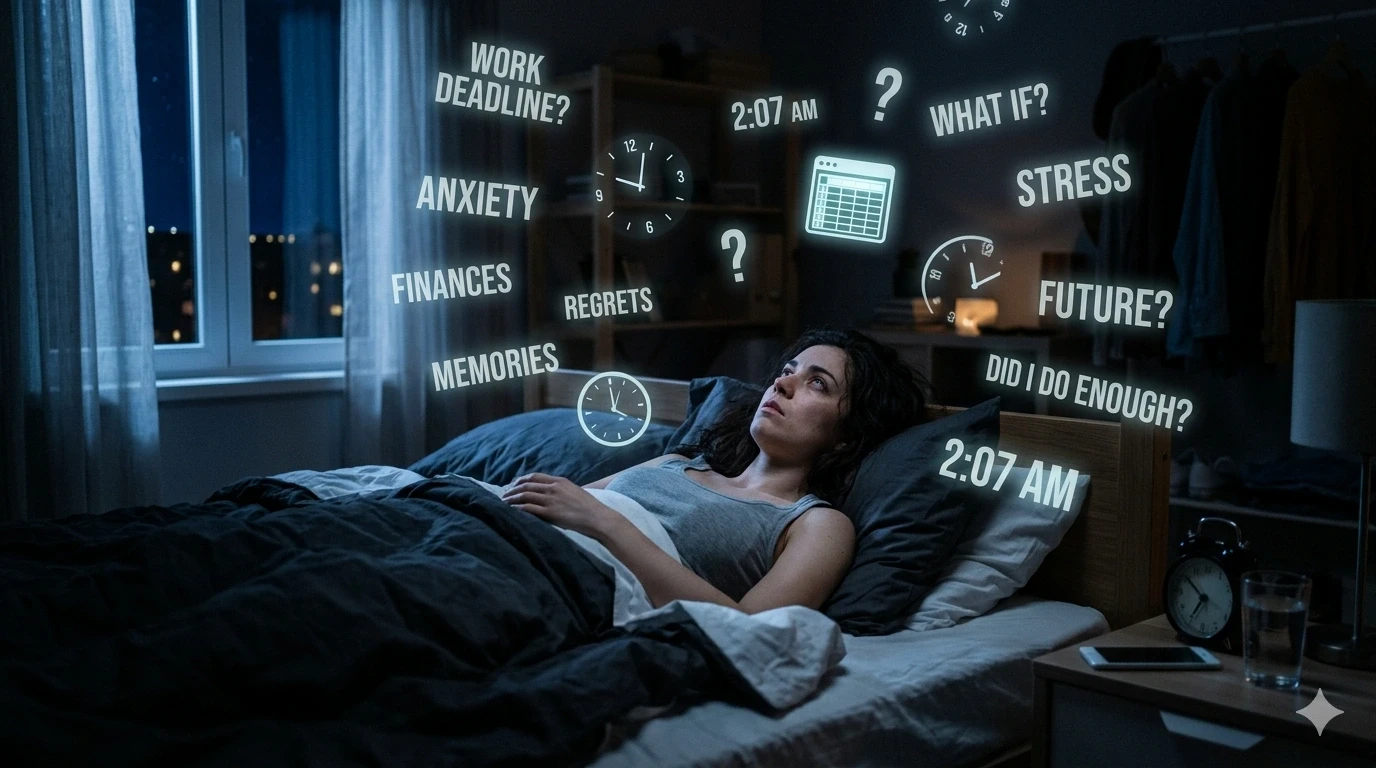
It's 2 a.m. You've been lying in bed for over an hour. Your body is exhausted, but your brain has apparently decided this is the perfect time to replay that awkward thing you said three years ago, stress about tomorrow's meeting, question every life decision you've ever made, and wonder if you turned the gas off.
Sound familiar?
You're not broken — you're overthinking, and it's one of the most common things that disrupts sleep in adults today. Many people lie awake asking themselves: why do I overthink everything at night? Or why does overthinking get worse at night when I am so tired? The good news? There are proven, therapist-backed ways to stop overthinking at night — and to finally learn how to sleep peacefully without overthinking taking over.
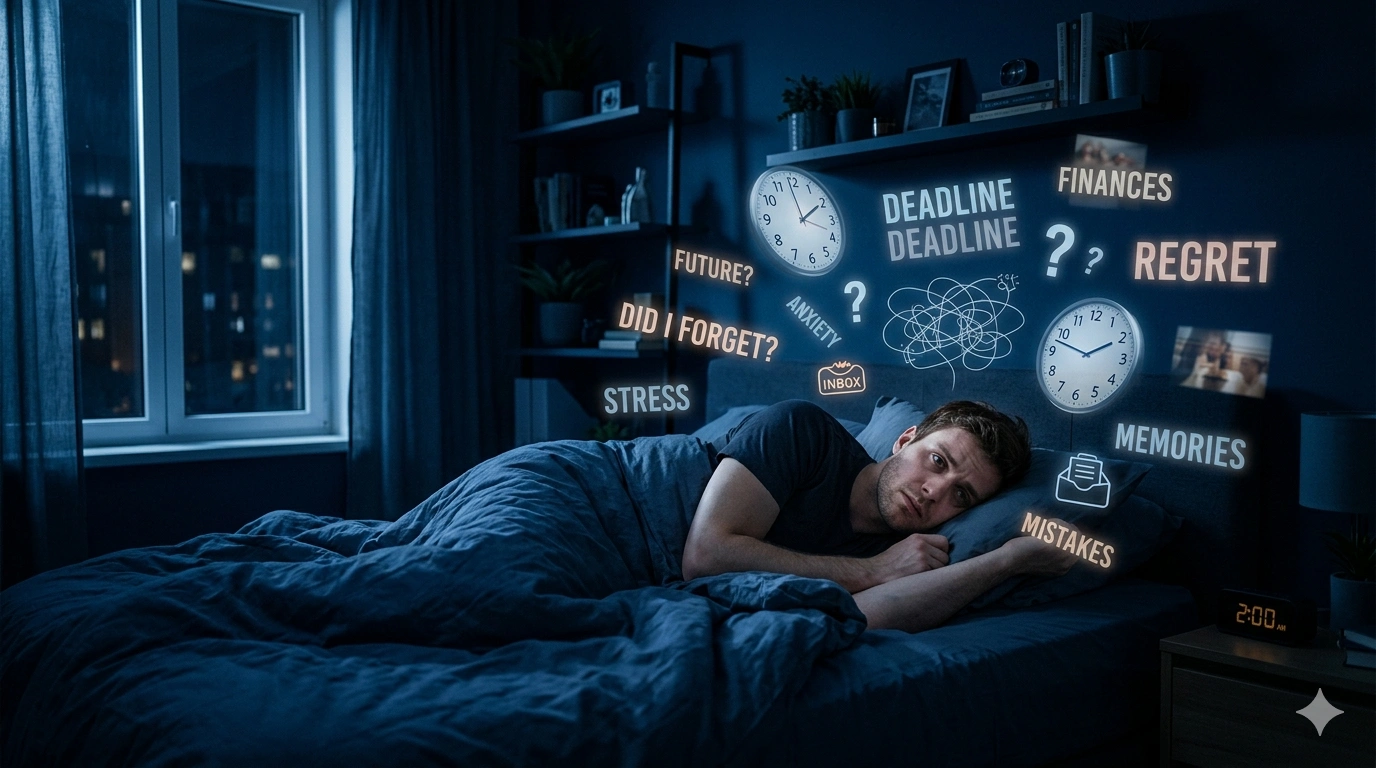
During the day, your brain has distractions — tasks, conversations, screens. But the moment you lie down in the dark, your default mode network (the part of your brain responsible for self-reflection and rumination) gets activated. With nothing else competing for attention, every unresolved thought rushes to the surface. This is what causes too many thoughts at night — your brain finally has space to process everything it pushed aside during the day.
Add to this the fact that cortisol levels naturally rise in the early morning hours, and it's a recipe for spiralling thoughts, physical restlessness, and a frustrating inability to sleep. If you also struggle with how to sleep better with anxiety, you are not alone — it is one of the most common complaints people bring to therapists.
The key isn't to force yourself not to think. The key is to give your brain something better to do.
One of the most effective techniques in Cognitive Behavioral Therapy (CBT) is scheduled worry time. It sounds counterintuitive, but it works.
Set aside 15–20 minutes in the early evening—not right before bed—and permit yourself to worry. Write down everything on your mind. What's bothering you? What are you afraid might go wrong? What haven't you resolved?
When those same thoughts try to resurface at 11 p.m., your brain has already "processed" them. Gently remind yourself: "I already worried about this." That time has passed."
This technique trains your brain to contain anxious thoughts to a specific time slot, rather than letting it leak into every quiet moment—including bedtime. It is one of the most effective answers to the question of how to stop negative thoughts before sleep from taking over your night.
If you skip the worry window, a brain dump journal is your last line of defence before sleep.
Grab a notebook (not your phone — screens stimulate your brain further) and spend 10 minutes writing down every thought circling your head. Not in a structured, diary-entry way. Just dump it all—to-do lists, fears, random observations, things you regret saying, things you need to buy. All of it.
There's research backing this up: a 2018 study published in the Journal of Experimental Psychology found that writing a to-do list for five minutes before bed helped people fall asleep significantly faster. The act of externalizing your thoughts releases the mental "loop" your brain keeps running.
Read More: ways to resolve misunderstanding,
When overthinking is driven by anxiety, your nervous system is in a low-grade fight-or-flight state. The 4-7-8 breathing technique, developed by Dr. Andrew Weil, directly activates your parasympathetic nervous system — the part responsible for rest and calm.
Here's how to do it:
The extended exhale is what does the heavy lifting. A long out-breath signals safety to your brain and body, gradually lowering heart rate and quieting the mental noise. To understand more about how this connects to your broader mental wellbeing, read about the effects of overthinking on emotional health.
Here's something most people don't realise: having a thought and believing a thought are two very different things.
Cognitive defusion is an Acceptance and Commitment Therapy (ACT) technique that helps you observe your thoughts rather than getting tangled up in them. Instead of thinking "I'm going to fail that presentation", you reframe it as: "I'm having the thought that I'm going to fail that presentation."
This small linguistic shift creates distance. The thought is no longer you — it's something your mind is doing, and you get to notice it without being consumed by it.
Another version: imagine your thoughts as clouds drifting across the sky. You are not the cloud. You are the sky — still, wide, and unaffected.
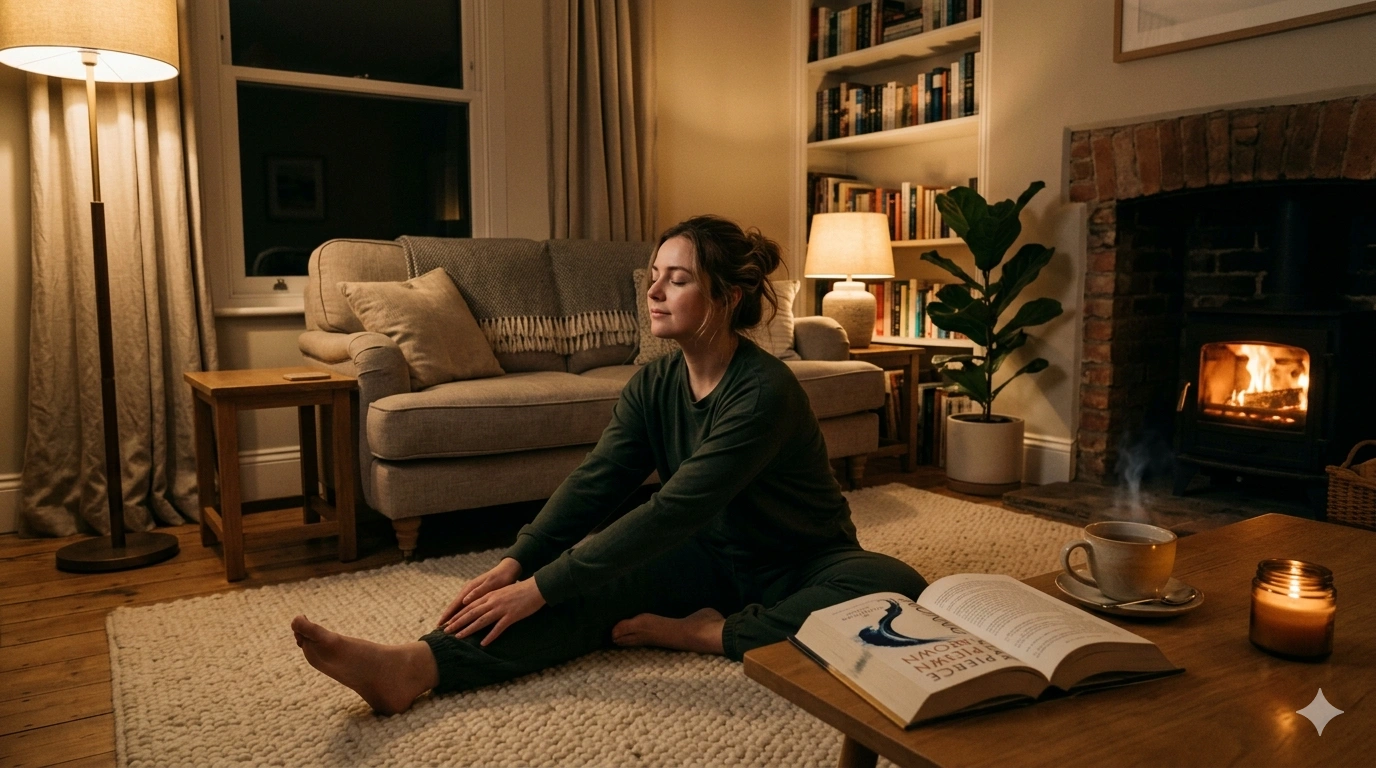
Progressive Muscle Relaxation (PMR) is a technique that systematically tenses and releases muscle groups from your toes to your head, grounding your awareness in physical sensation rather than mental chatter.
Start with your feet. Tense them tightly for 5 seconds, then release. Move to your calves, thighs, stomach, hands, shoulders, and face. With each release, your body surrenders a little more tension — and your mind follows.
You can do this entirely in your head, without any app or audio. It takes about 10–15 minutes and works particularly well for people whose overthinking is accompanied by physical restlessness or muscle tension. Research cited by the Sleep Foundation confirms that body-based relaxation techniques significantly improve sleep quality in people with anxiety-related sleep disruption.
This sounds maddening, but one of the biggest contributors to nighttime overthinking is the anxiety about not sleeping. The harder you try to sleep, the more activated your brain becomes.
Sleep scientists call this sleep effort — the harder you try, the more alert you become. The solution is something called paradoxical intention: instead of trying to sleep, try to stay awake with your eyes closed. Don't do anything stimulating — just lie there, eyes closed, and permit yourself to be awake.
Removing the pressure to sleep dramatically reduces the anxiety that fuels overthinking, and most people drift off within minutes without even noticing.
Your brain learns from patterns. If you spend your evenings scrolling through alarming news, replying to work emails, and stimulating your nervous system right up until bed, it doesn't know that "bed" means "off."
A consistent wind-down routine — the same sequence of calming activities for 30–60 minutes before sleep — teaches your brain that what follows is rest. This could include:
Over time, your brain begins to associate these cues with sleep, making it easier to quiet the mental noise when your head hits the pillow. Understanding the link between stress and sleep quality can help you build this routine with more intention.
A big source of nighttime overthinking is unresolved logistics. What do I need to do tomorrow? Did I forget something important?
Before bed, spend two minutes writing a simple, clear plan for the next day. Not an overwhelming list — just the three most important things. This offloads the cognitive load of "holding" those tasks in your mind overnight and reassures your brain that nothing will slip through the cracks while you sleep.
Your brain processes information it takes in during the hours before sleep. News, social media, tense conversations, work messages — these are all inputs that your brain will continue to work through after you close your eyes.
Try implementing a soft "information blackout" after 8 p.m. Not because information is bad, but because your brain needs time to process what it's already absorbed before adding more.
If nighttime overthinking happens occasionally, the techniques above will usually be enough. But if you find yourself lying awake most nights, feeling persistently anxious, or noticing that it's affecting your work, relationships, or quality of life — that's worth taking seriously.
Chronic overthinking and sleep disruption are often signs of underlying anxiety, and anxiety responds extraordinarily well to therapy. Techniques like CBT and ACT (the same frameworks behind many of the tips in this article) work even more powerfully when guided by a trained therapist. If you haven't already, take a moment to read what overthinking actually is and how to stop it before it hurts you — it's a helpful companion to this guide.

If you're in India, Online Therapy to Stop Overthinking is now accessible, affordable, and completely confidential at My Fit Brain. Our licensed therapists work with chronic overthinkers using evidence-based approaches that produce real, lasting results — not just temporary relief.
You deserve to sleep. You deserve a quiet mind. And you don't have to figure it out alone.
Learning how to stop overthinking at night is less about silencing your brain and more about changing your relationship with your thoughts. You don't need to eliminate every worry — you just need to stop letting those worries run the show when you're trying to rest.
Start with one technique tonight. Try the brain dump, or the 4-7-8 breathing, or the worry window. Give it a week. Notice what shifts.
And if the overthinking feels bigger than a bedtime technique can solve, that's okay too. That's what therapy is for. Book a session with a licensed therapist through Online Therapy to Stop Overthinking at My Fit Brain — confidential, affordable, and available online from anywhere in India.
Your mind deserves rest. Let's get you there.
During the day, your brain is occupied with tasks, conversations, and sensory input — all of which act as natural distractions from internal thought loops. At night, when external stimulation drops away and the room goes quiet, your default mode network activates. This is the part of your brain responsible for self-referential thinking and planning, and without competition from the outside world, it runs freely. Add low lighting, stillness, and fatigue to the mix and your unresolved thoughts have the perfect conditions to spiral.
Not always. Occasional nighttime overthinking is a normal human experience, especially during stressful periods. However, if it happens most nights, significantly disrupts your sleep, causes physical symptoms like a racing heart or chest tightness, or is affecting your daily functioning, it may be a sign of Generalised Anxiety Disorder (GAD) or another anxiety-related condition. In that case, speaking to a licensed therapist is strongly recommended rather than relying solely on self-help strategies.
Some techniques — like the 4-7-8 breathing or cold water method — can produce noticeable calm within 3 to 5 minutes of use. Others, like the worry window or consistent wind-down routine, require several days to two weeks of practice before you notice a meaningful difference. This is because they work by retraining habitual thought patterns and nervous system responses, which takes repetition. Try any technique consistently for at least 7 nights before deciding whether it works for you.
Yes, chronic sleep disruption caused by overthinking has well-documented health consequences over time. These include weakened immunity, increased risk of cardiovascular disease, impaired memory and concentration, weight changes, and a significantly higher risk of developing anxiety and depression. This is why addressing nighttime overthinking is not just about comfort — it's a genuine health priority worth taking seriously.
Medication is one option that a psychiatrist may recommend in certain cases, particularly where anxiety is severe or where sleep deprivation is becoming dangerous. However, most clinical guidelines suggest that psychological therapies — particularly CBT and ACT — should be the first line of treatment for anxiety-related overthinking, either alone or alongside medication. If you're considering this route, speak to a qualified mental health professional who can assess your individual situation rather than self-medicating.

Online
English, Punjabi, Haryanvi
Couple Counseling, Marital Counselling, LGBTQ, Addiction, Depression

It's 7pm. You've been making decisions since you woke up , wh...
 27 Jun 2026 9 min Read 1.2k Reads
Think about the last time a conversation with someone you love went wrong. ...
26 Jun 2026 9 min Read 1.2k Reads 
Nobody told you your childhood was hard. That's part of the probl...
24 Jun 2026 9 min Read 1.5k Reads 
You can be surrounded by people and still feel completely alone. Most...
23 Jun 2026 9 min Read 887 Reads 
Area Of Expertise : Couple Counseling, Marital Counselling, LGBTQ, Addiction, Depression, Family Counseling, Relationship Counselling, Anger Management, Sexual Wellness, Marriage & Couple Counselling
Book a Session
Better mental health at your convince
